
Last Updated on January 27, 2026 6:51 pm by BIZNAMA NEWS
Staff Reporter / New Delhi
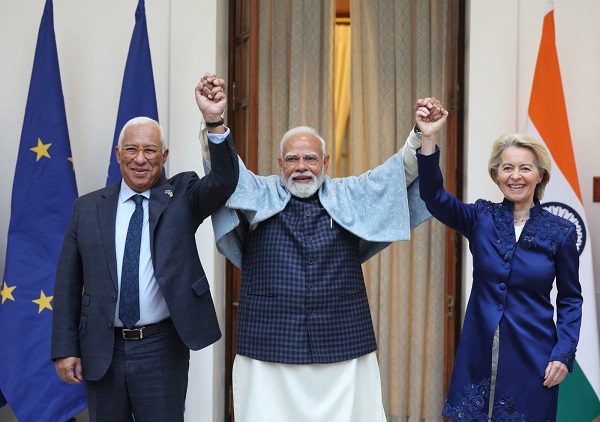
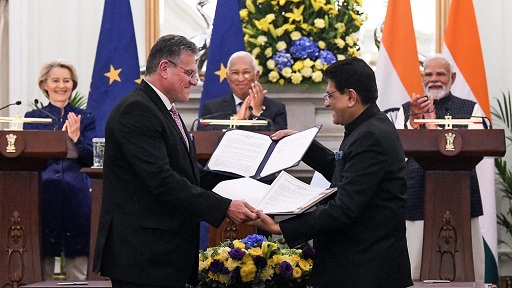
India and the European Union Tuesday signed the historic Free Trade Agreement following the India-EU Summit between Prime Minister Narendra Modi, President of the European Council Antonio Costa and President of the European Commission Ursula von der Leyen in New Delhi. India and the European Union also exchanged several agreements following talks between the leaders, including in the fields of trade, security, defence partnership, mobility, disaster risk management, and green hydrogen.
In his Joint Statement following the exchange of agreements, Prime Minister Modi termed the Free Trade Agreement as historic, saying it will benefit farmers and MSMEs. He highlighted that India today inked its biggest free trade deal with the European Union. He said, this will boost investment, form new innovation partnerships and strengthen supply chains at the global level.
Speaking on this occasion, the Prime Minister said that India and the European Union relations have strengthened, and ties have reached new heights. He said, this is not just a trade agreement, but a new blueprint for shared prosperity.
Prime Minister Modi added that the Security and Defence Partnership between India and the EU will deepen cooperation in counter terrorism, maritime and cyber security. He noted that the India-EU partnership is for the global good. He opined that there is churning in the global order today, and India -EU ties will bring stability in this.
Prime Minister Modi stressed the reforms of global institutions, saying this historic Summit is a turning point. In his statement, President of the European Council Antonio Costa said that today’s Summit sends a clear message to the world that India and the EU stand together as strategic and reliable partners at a time when the global world is being reshaped. He said that together, India and the EU must show leadership on global issues.
In her statement, President of the European Commission Ursula von der Leyen termed the India-EU FTA as the mother of all deals. She said it will create jobs for millions of workers in India and Europe. She thanked Prime Minister Narendra Modi for the exceptional hospitality, adding that it was an honour to be the Chief Guest at the Republic Day parade. She said, India has risen, and Europe is truly glad about it. She said, when India succeeds, the world is more stable, prosperous and secure.
Transforming Trade and Investment
The FTA delivers unprecedented market access for Indian exports, with preferential access across 97% of EU tariff lines, covering 99.5% of India’s export value. Crucially, over 70% of tariff lines – representing more than 90% of India’s exports – will see immediate duty elimination, benefiting labour-intensive sectors such as textiles, apparel, leather, footwear, marine products, gems and jewellery, toys, sports goods, tea, coffee, and spices.
These sectors, currently facing EU import duties ranging from 4% to 26%, are central to employment generation and MSME growth in India. With zero-duty access from the FTA’s entry into force, Indian exporters are expected to gain enhanced competitiveness, deeper integration into European value chains, and greater certainty in long-term investment planning.
On the other side, India has offered market access across 92.1% of its tariff lines, covering 97.5% of EU exports. This includes immediate duty elimination on nearly half of tariff lines and phased liberalisation over 5, 7, and 10 years on others. Enhanced access for high-technology European goods is expected to diversify India’s import sources, reduce input costs, and support domestic manufacturing and global value chain integration.
Boost for Agriculture, MSMEs and Jobs
Agriculture and processed food sectors stand to gain significantly, with preferential access for products such as tea, coffee, spices, grapes, gherkins, cucumbers, dried onion, fresh fruits and vegetables, and several processed foods. This improved market access is expected to strengthen farmers’ incomes, support rural livelihoods, and enhance India’s position as a reliable supplier of high-quality agricultural products to Europe.
At the same time, India has safeguarded sensitive sectors—including dairy, cereals, poultry, soymeal, and select fruits and vegetables – ensuring that export growth remains balanced with domestic priorities.
Labour-intensive industries such as textiles, leather, footwear, marine products, plastics, rubber, chemicals, and engineering goods are projected to see a sharp rise in exports, employment, and MSME-led industrial growth. Engineering exports alone, currently valued at over USD 16 billion to the EU, are poised to expand their share in Europe’s nearly USD 2 trillion import market.
Services, Mobility and Talent at the Core
Recognising services as a key driver of future trade, the FTA secures broad and deep commitments across 144 services subsectors from the EU, including IT/ITeS, professional services, education, business services, and digitally delivered services. Indian service providers gain a stable, non-discriminatory regime in the EU, while EU firms receive predictable access to India’s growing services market.
A robust mobility framework ensures assured temporary entry and stay for professionals such as business visitors, intra-corporate transferees, contractual service suppliers, and independent professionals. The agreement opens opportunities across dozens of subsectors, particularly in IT, R&D, education, and professional services, strengthening India’s position as a global talent hub.
The FTA also provides a pathway for future Social Security Agreements with EU Member States and supports continued mobility of Indian students, including post-study work opportunities.
New Frontiers: Traditional Medicine, Innovation and Standards
For the first time, the agreement creates new avenues for Indian traditional medicine. In EU Member States where regulations permit, AYUSH practitioners will be able to offer services based on qualifications obtained in India, while the framework ensures certainty for establishing AYUSH wellness centres and clinics across Europe.
The FTA reinforces intellectual property protections in line with TRIPS, affirms the Doha Declaration, and recognises the importance of India’s Traditional Knowledge Digital Library (TKDL). Enhanced cooperation on sanitary and phytosanitary (SPS) measures and technical barriers to trade (TBT) will facilitate smoother, safer, and more predictable market access through regulatory cooperation, digitisation, and mutual recognition of conformity assessments.
Beyond Trade: A Comprehensive Strategic Agenda
The FTA forms part of a broader elevation of India-EU relations, reflected in the adoption of the “Towards 2030: A Joint India-European Union Comprehensive Strategic Agenda.” During the high-level visit, both sides concluded or announced a wide range of agreements spanning trade, security, technology, mobility, clean energy, disaster management, and connectivity.
Key outcomes include a renewed India-EU Agreement on Scientific and Technological Cooperation (2025-2030), exploratory talks on India’s association with the Horizon Europe programme, the launch of a Green Hydrogen Task Force, enhanced defence and security cooperation, and new frameworks on mobility, skilling, disaster risk management, and digital innovation.
Together, these initiatives signal a shift from a traditional partnership to a modern, multifaceted strategic alliance – anchored in trade, powered by innovation and talent, and guided by shared values of sustainability, transparency, and inclusive growth.
As India and the European Union look ahead, the landmark FTA is set to become a cornerstone of their relationship, driving economic growth, creating jobs, strengthening global competitiveness, and positioning both partners as key pillars of a stable and rules-based global order.