
SHOBHA SHUKLA – CNS
If one assumes that artificial intelligence (AI) is for the ‘haves’ and not ‘have-nots,’ then let us dive deeper into how AI is helping reach the unreached populations with state-of-the-art public health services. Not just Global North, but several countries of the Global South too are shattering this stereotype of ‘AI for the rich and mighty’ by deploying AI to serve the most underserved communities and helping overcome access barriers. This becomes even more important when such person-centred AI tools comes from Global South innovators like DeepTek.
Before the largest TB and lung disease conference opens this year (Asia Pacific Regional Conference of the International Union Against Tuberculosis and Lung Disease or APRC 2026), let us dive deeper in how AI has been deployed in the region as well as globally to serve the underserved.
Unless we prevent all TB infection, find all those with TB disease and link them to treatment, care and support pathway, the #endTB goal would remain elusive. When we miss TB cases, TB infection spreads, people suffer.
Finding TB early and accurately has been a formidable challenge till recently. Due to access barriers faced by those who are at higher TB risk as well as bad diagnostic tests like microscopy (which missed half or more of TB among those who took a TB test), we were (and are) failing to find all TB. Unless we find all TB, we cannot stop the spread of infection (because soon after initiation of right treatment, lung TB stops spreading) and reduce avoidable human suffering and untimely deaths.
Only 58 months left to end TB: Keep the promise!
In 2023 when all world leaders met at the UN General Assembly High Level Meeting on TB, they promised to find at least 90% of all people with TB by 2027 and link them with standard services for treatment, care and support. Earlier, all world leaders had committed to deliver on Sustainable Development Goals (SDGs), one of the target is to end TB by 2030. But this is easier said than done.
One critical challenge is that we have to find people with TB disease when they have no symptoms. Several government-led surveys show that almost half of TB is among the asymptomatic and could only be detected with X-Rays. But access to radiology is limited and radiologists even more scarce. This is where AI-enabled TB detection comes as a saviour.
AI-enabled handheld and ultraportable X-Rays (battery operated) are increasingly being taken to the communities (even in far and remote areas) and screen everyone – regardless of TB symptoms.
Several countries in Asia and the Pacific region deploys AI to screen people who are at a higher risk of TB but least likely to access care. These include homeless people, migrant workers, people in prisons, among others. TB is the deadliest infectious disease globally.
AI turning point
In July 2021, WHO had integrated AI powered computer-aided detection software into its official guidelines for TB screening and diagnosis to help bridge the “missing millions” gap in detection. AI powered software can be used to interpret digital chest X-rays for TB screening.
This was historically the first time ever when AI powered computer-aided detection software was recommended for use in interpreting chest X-Rays for TB.
AI accuracy similar to that of human radiologists
Several studies show that AI-enabled computer-aided detection software can achieve highly sensitive TB detection in population-based screening and has accuracy on-par with human readers.
Generally speaking, AI became a substitute for a human expert reader in places where experts were not available (for example, a radiologist or trained medical officer) to detect abnormalities consistent with TB and avoid delays in the care pathway.
This was a big gamechanger because availability of human experts is often scarce in low- and middle-income countries. And it saves time of experts where AI can be of help. And who was getting benefitted the most? Underserved people.
India made a foundational shift following science and evidence
India, a country with highest TB burden globally, led from the front and made a foundational shift worldwide on 7th December 2024 by being the first country globally to screen everyone in high-risk settings for TB with artificial intelligence (AI) enabled handheld X-Rays and offer them upfront molecular test Truenat and linkage to appropriate treatment, care and support. Initially this drive was launched in almost half of districts in the country and later expanded nationwide (as per the concept note of government of India).
Within the first 100 days, India screened over 120 million people across the country in high-risk settings – most of them were screened with AI-enabled X-Rays.
In the first 100 days, Indian government’s TB programme could find over 285,000 people who had no TB symptom (asymptomatic or sub-clinical TB) – thanks to AI. None of the TB asymptomatic people would have been found if AI-enabled X-Rays were not taken closer to the communities or at people’s doorstep.
Real gamechanger was AI because within few seconds the AI generated report told the person whether he/ she or they had presumptive TB. Some AIs like that of DeepTek CXR AI (Genki) can scan a person within seconds for over 20 findings.
AI saves money and helps save lives
AI helped save and maximise financial resources because it was very cost effective and high impact public health intervention when it comes to finding all TB in high-risk settings. In an ideal world, everyone in high-risk settings (with or without TB symptoms) should get an upfront molecular test but this would be an extremely costly approach. AI helps screen people at much lower costs and those presumptive for TB are triaged for upfront molecular testing for confirmation of active TB disease, and linkage to care continuum.
The findings of the Indian government-led Health Technology Assessment of India Study published in 2025 further reinforce cost-effectiveness of using AI for finding more TB. This study compared AI tools with manual interpretation of chest X-Ray to assess cost-effective as well as sensitivity and specificity.
The study found that pooled sensitivity and specificity of AI tools met the criteria of WHO consolidated guidelines for TB screening – and not inferior to manual interpretation of chest X-Rays.
That is why this study strongly recommended AI enabled interpretation of chest X-Rays especially where resources are scarce.
DeepTek’s AI making a difference worldwide
Recommended by the WHO for AI-powered TB detection, DeepTek’s AI automatically analyses the chest X-Rays (CXR) for over 20 conditions of the chest. Along with Genki, DeepTek’s Augmento offers a robust radiology AI platform.
“DeepTek’s CXR AI- Genki, met the WHO performance standards in community-based and facility-based screening for TB of the lungs in people over 15 years of age,” said Mohit Agarwal, Senior Director of DeepTek. Mohit is among the experts at APRC 2026 and Genki is being exhibited for all delegates. “DeepTek CXR AI is also compliant with The Global Fund Quality Assurance Policy,” he said.
All public hospitals in Singapore deploying DeepTek’s Radiology Solutions
Singapore government is adopting DeepTek’s solutions at the national level across all public hospitals.
Several regulatory agencies globally have validated or approved DeepTek’s CXR AI and at varying level of rollout. These regulators include US FDA and those of countries/ regions like European Union, , Thailand, Singapore, India (Indian Council of Medical Research – ICMR and Central Drugs Standard Control Organisation – CDSCO), Philippines, Malaysia, Indonesia, Kenya, UK, South Africa among others.
“Currently DeepTek’s solutions is deployed in more than 1000 hospitals and medical imaging centres (paying centres), and over 500 government-run public health screening sites globally, screening over 3 Million people across the globe,” said Mohit Agarwal.
With Genki number of those detected with TB doubled
Underpinning the much-needed impact of Genki deployment on finding more people with TB, Mohit Agarwal said that over half a million people were screened for TB with Genki in Tamil Nadu, a state in southern India.
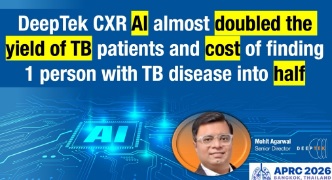
“Genki almost doubled the yield of TB patients, with 0.63% of people who were screened diagnosed with TB disease in districts of Tamil Nadu where Genki was deployed. This was compared with districts of the state without Genki where 0.36% of those verbally screened for TB symptoms were diagnosed with TB disease,” said Mohit.
Cost of finding 1 person with TB disease halves with use of AI
“Cost of identifying one person with active TB disease is almost halved when Genki is used,” said Mohit Agarwal. Cost to find 1 person with TB disease without AI was INR 106,342 (US$ 1,250) whereas the cost to find one person with TB with Genki AI reduced to INR 58,607 (US$ 688).
“More importantly we see an impact on quality of life because through the use of Genki, we are able to find patients who are sub-clinical or those who have no symptoms yet. So impact of medication is better and so is the impact on quality of life,” added Mohit.
“One of the key learnings is that when the same AI product is used in different cohorts (for example, different X-Ray machines, age groups, ethnicities, genders or other such parameters) we have slightly different accuracies. For example, in different districts of Tamil Nadu we saw different accuracies of AI, however overall efficacy numbers (sensitivity and specificity numbers) remained fairly high around 92%,” he said.
Responsible AI
“Responsible AI is one of the key innovations we have brought in, where while using this platform, we automatically compare the AI outcome with sputum results and radiology reviews. And we help you identify what is the efficacy of AI at your given setting and help you tune the AI to your specific setting,” shared Mohit Agarwal.
With increasing deployment of AI enabled X-Rays and molecular tests in low- and middle-income countries, globally we were never so prepared ever before – for multi-disease point-of-care screening with AI and multi-disease point-of-care molecular testing using the same diagnostic infrastructure in the Global South. Let us hope all governments follow the science and evidence and help serve the underserved with equity and rights.