
Last Updated on February 10, 2026 4:23 pm by BIZNAMA NEWS
R. Suryamurthy
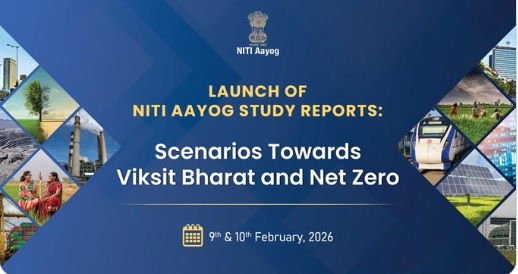
NITI Aayog’s Scenarios towards Viksit Bharat and Net Zero represents India’s first major official effort to quantify how long-term climate commitments will shape economic growth, household incomes, and consumption patterns. Far beyond an emissions or energy-transition roadmap, the report carries a sharper macroeconomic signal: India’s journey to Net Zero is effectively a structural economic transformation. It will influence not only how GDP expands, but also how jobs are created, how household earnings evolve, and how Indians consume over the next two decades as climate risks and transition costs become embedded in the development model.
The modelling suggests that Viksit Bharat by 2047 remains achievable across all scenarios, but the composition of growth—and its distribution across households—changes materially as climate risks and transition costs are internalised.
GDP Growth: Composition Matters More Than Speed
The macroeconomic analysis indicates that India can sustain high GDP growth even under Net Zero-aligned scenarios, but growth becomes more investment-driven and capital-intensive. Large-scale spending on clean power, transport, industry and infrastructure offsets productivity losses from climate damage and rising transition costs.
However, this growth is unevenly distributed across sectors. Energy-intensive, carbon-heavy activities gradually lose relative importance, while clean manufacturing, services, construction and digital sectors gain prominence. The implication is that headline GDP numbers may remain robust even as structural shifts disrupt specific regions and labour markets.
Importantly, the study flags climate change itself as a drag on GDP if left unmanaged—through lower agricultural output, infrastructure damage and health costs. In that sense, climate investment is presented less as a growth sacrifice and more as insurance against future GDP erosion.
Household Incomes: Transition Creates Winners and Losers
For households, the transition reshapes income sources rather than simply raising or lowering aggregate income. Job creation in clean energy, construction, manufacturing and services supports income growth in urban and semi-urban areas, while productivity improvements and diversification become essential for sustaining rural incomes.
At the same time, the reports acknowledge distributional risks. Rising energy prices during the transition phase, especially if external finance remains expensive, could compress real household incomes, particularly for lower-income groups. Without targeted policy support, the cost of adjustment risks falling disproportionately on vulnerable households.
This makes public intervention—through skilling, social protection and targeted subsidies—critical to ensuring that income growth under Viksit Bharat remains broad-based rather than enclave-driven.
Consumption: From Energy-Heavy to Efficiency-Led
Consumption patterns shift markedly in Net Zero-aligned scenarios. As electrification deepens and efficiency improves, energy consumption grows more slowly than GDP, reducing household exposure to fuel price shocks over time.
However, the transition phase is marked by adjustment costs. Households may face higher upfront costs for electric vehicles, efficient appliances and housing retrofits, even if lifetime costs are lower. This creates a timing mismatch between investment and savings, with implications for consumption demand.
Mission LiFE and behavioural change feature prominently in the modelling, signalling that future consumption growth is expected to be less material- and energy-intensive. While this supports sustainability, it also implies that traditional consumption-led growth drivers may weaken, pushing the economy to rely more on investment and exports.
Inflation, Trade and Purchasing Power
The macroeconomic report also flags climate-related inflation risks, particularly through food prices and supply-chain disruptions. If climate impacts on agriculture intensify faster than adaptation investments, household purchasing power could come under pressure—even if nominal incomes rise.
On the external front, Net Zero alignment reduces long-term exposure to fossil fuel import shocks but increases dependence on imported capital goods and critical inputs in the near to medium term. This has indirect effects on prices, employment and household welfare.
Financing and Its Household Spillovers
The financing requirement—estimated at over $22 trillion by 2070—has direct implications for households. Higher investment boosts employment and income, but if financed through higher borrowing costs or indirect taxes, it can crowd out household consumption.
NITI Aayog’s emphasis on affordable external finance reflects an implicit concern: without low-cost capital, the burden of transition could be passed on to households through higher prices, reduced subsidies or fiscal compression.
Consumption as a Policy Variable
A notable shift in the analysis is the treatment of consumption itself as a policy lever. Demand moderation, efficiency and behavioural change are no longer framed as sacrifices, but as macroeconomic stabilisers that reduce import dependence, inflation volatility and fiscal stress.
This marks a departure from earlier growth models that relied heavily on rising household consumption as the primary growth engine.
The Household Test of Viksit Bharat
NITI Aayog’s Net Zero scenarios ultimately suggest that India can grow richer, cleaner and more resilient at the same time—but only if GDP growth translates into rising real household incomes and stable consumption.
If transition costs are poorly managed, households risk experiencing higher prices and income uncertainty even as aggregate GDP rises. If managed well, the shift can deliver more stable incomes, lower energy vulnerability and a consumption model better aligned with long-term sustainability.
In that sense, Viksit Bharat will not be judged by GDP alone, but by whether Indian households feel richer, more secure and less exposed to economic and climate shocks in the decades ahead.