
Last Updated on February 12, 2026 11:30 am by BIZNAMA NEWS
T N ASHOK
Five decades after its birth in blood and liberation — carved out of Pakistan in 1971 with decisive Indian military support and the courage of the Mukti Bahini — Bangladesh heads to the polls in one of the most consequential elections in its history.
The vote comes in the turbulent aftermath of a student-led uprising that began as protests against public-sector job quotas but quickly snowballed into a nationwide revolt against entrenched power. The movement ultimately forced the resignation of long-serving Prime Minister Sheikh Hasina, whose 15-year rule combined strong economic growth and infrastructure expansion with mounting allegations of political repression and shrinking democratic space.
Facing escalating unrest, Hasina fled to India, where she remains in exile — a development that has injected new strain into otherwise robust India-Bangladesh ties.
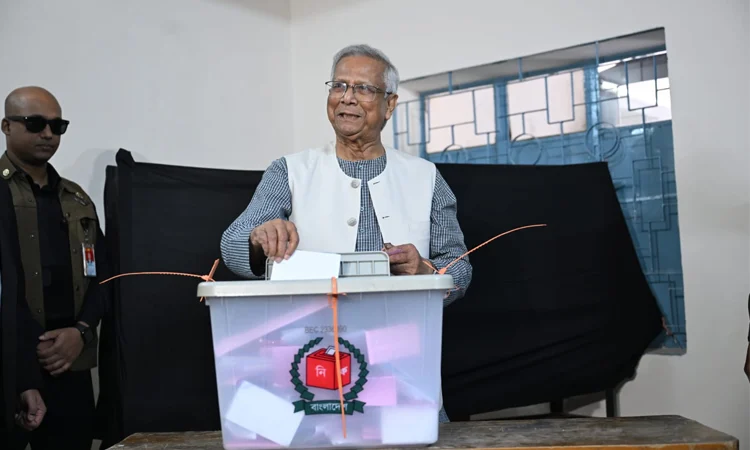
In the vacuum that followed, Nobel Peace Prize laureate Muhammad Yunus was elevated to head an interim administration, promising institutional reform and electoral restoration. His ascent was welcomed in Western capitals, though critics at home question the durability of a technocratic experiment in a deeply polarized political landscape. Islamist party Jamaat-e-Islami, long constrained under Hasina’s rule, has re-emerged as a significant political force amid the reshuffle.
Now, as Bangladesh prepares to choose its next government, the Bangladesh Nationalist Party (BNP) — founded by former president Ziaur Rahman and led in exile for years by his son Tarique Rahman — appears poised for a dramatic comeback.
With the recent passing of former Prime Minister Khaleda Zia, sympathy and legacy politics have re-energized the party’s base. Tarique Rahman, operating from London but wielding growing influence at home, is widely viewed as a formidable challenger to the Yunus-backed reform platform.
This election is therefore more than a contest between personalities. It is a referendum on political legacy versus technocratic transition; on dynastic resilience versus generational revolt; and on how a strategically located South Asian nation will recalibrate its relations with India, China, the United States and the wider Islamic world.
Bangladesh was born in revolution. Half a century later, it is once again asking whether upheaval can be converted into stable democratic order.