
Last Updated on February 24, 2026 4:52 pm by BIZNAMA NEWS
AMN / Ranchi
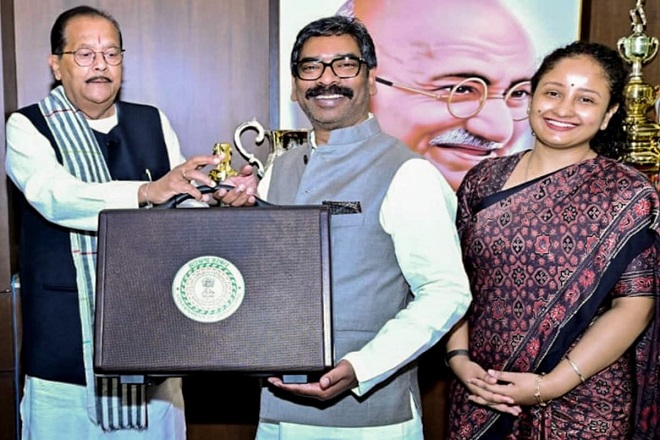
Emphasising social justice, women’s empowerment, agricultural expansion and infrastructure-led growth, the Jharkhand government has presented a ₹1,58,560 crore Budget for the financial year 2026–27. The “Abua Dishom” Budget was tabled in the Assembly by Finance Minister Radhakrishna Kishore, marking his second consecutive financial statement. The outlay is nearly 9 per cent higher than last year’s ₹1,45,400 crore Budget, signalling an expansionary yet fiscally managed approach.
Centre-State Financial Concerns
During his Budget speech, the Finance Minister flagged concerns over what he termed inadequate financial support from the Centre. He stated that nearly ₹16,000 crore — including ₹5,000 crore in tax devolution and ₹11,000 crore in grants — had not been received as expected. Additionally, GST rate rationalisation has allegedly resulted in an annual revenue loss of about ₹4,000 crore for the state.
He also pointed out that the 60:40 cost-sharing burden under MGNREGA has added an extra liability of ₹5,640 crore on Jharkhand. Despite these pressures, the Minister asserted that under the leadership of Chief Minister Hemant Soren, the government ensured that salaries were not delayed and welfare commitments were fulfilled, including ₹13,000 crore spent under the Maiya Samman Yojana.
Budget Structure and Fiscal Indicators
The total Budget size of ₹1,58,560 crore includes ₹1,20,851.90 crore as revenue expenditure and ₹37,708.10 crore as capital expenditure. The 8.5 per cent rise in capital spending reflects a stronger focus on infrastructure and asset creation.
The fiscal deficit is estimated at ₹13,595.96 crore, which is 2.18 per cent of the Gross State Domestic Product (GSDP), while the debt-to-GSDP ratio has been contained at 25.3 per cent.
Revenue mobilisation projections include ₹46,000 crore from state taxes, ₹20,700 crore from non-tax revenue, ₹51,236.38 crore from the state’s share in central taxes, ₹18,273.66 crore in central assistance, and ₹22,049.96 crore through public borrowings. The plan-to-establishment expenditure ratio has improved to 36:64, indicating greater prioritisation of developmental spending.
Agriculture and Allied Sectors
Strengthening agriculture remains a key priority. The allocation for the Birsa Seed Production Scheme has been increased from ₹95 crore to ₹145 crore. Soil and water conservation schemes, including fallow land development and “Jalnidhi” initiatives, have been allocated ₹475.50 crore.
Solar-powered irrigation systems will receive ₹75 crore, while ₹80 crore has been earmarked for distribution of farm machinery. The Jharkhand Millet Mission has been allocated ₹25 crore, and ₹19.88 crore has been set aside for cash crop promotion. Overall, agriculture and allied sectors will receive ₹4,884.20 crore.
Rural Development and Housing
Under MGNREGA, more than 10 crore person-days have reportedly been generated. The Abua Awas Yojana has sanctioned 6.33 lakh houses, of which 1.88 lakh have been completed. An allocation of ₹4,100 crore has been proposed for the upcoming financial year.
The total rural development outlay stands at ₹12,346.90 crore. Irrigation projects have been allocated ₹1,137.10 crore, while minor irrigation schemes will receive ₹215 crore.
Women Empowerment and Social Security
Women’s welfare continues to receive major emphasis. The Maiya Samman Yojana provides ₹2,500 per month to women aged 18–50 years, with a budgetary provision of ₹14,065.57 crore. Social security pensions and related schemes account for several thousand crore rupees, while the total outlay for women and child development stands at ₹22,995.69 crore.
Education and Skill Development
The state is operating 80 Excellence Schools and 325 Leader Schools. Elementary and secondary education have been allocated ₹16,251.43 crore, while higher and technical education will receive ₹2,564.45 crore.
Upgradation of technical institutions on IIT/NIT models, new universities and colleges, teacher training, and digital learning initiatives form key components of the education roadmap.
Health Sector Expansion
The Health and Family Welfare Department has been allocated ₹7,990.30 crore. A special ₹200 crore cancer treatment scheme has been proposed, along with the installation of PET-CT and Cath Lab facilities in medical colleges. The government aims to open 750 “Abua Dawakhana” clinics and expand MBBS seats in state institutions.
Infrastructure and Energy
Jharkhand’s road network has expanded to 15,066 km. The Road Construction Department has been allocated ₹6,601.28 crore, while the Rural Works Department will receive ₹5,081.74 crore.
In the energy sector, provisions include 200 units of free electricity for eligible households, renewable energy subsidies, and expansion of the Patratu power plant, with a total allocation of ₹11,197.89 crore.
Industrial Investment and Global Outreach
The government claimed to have received investment proposals worth ₹1,24,230 crore, potentially generating 45,000 jobs. In 2026, Jharkhand participated for the first time in the World Economic Forum meeting at Davos, presenting itself as an emerging destination for sustainable green energy, critical minerals, and forest-based value chains.
PESA Implementation
The Panchayats (Extension to Scheduled Areas) Act (PESA) has been implemented in the state from January 2, 2026, empowering Gram Sabhas in Scheduled Areas with greater control over sand ghats, rural markets, and beneficiary selection.
Conclusion
The 2026–27 Budget attempts to balance welfare commitments with capital investment, while maintaining fiscal discipline. With a strong emphasis on inclusive growth, women’s empowerment, agricultural productivity, infrastructure development, and industrial expansion, the Jharkhand government has positioned the “Abua Dishom” Budget as a roadmap for sustainable and socially equitable progress.