

Last Updated on March 10, 2026 4:11 pm by BIZNAMA NEWS
ANDAALIB KHTER / NEWDELHI
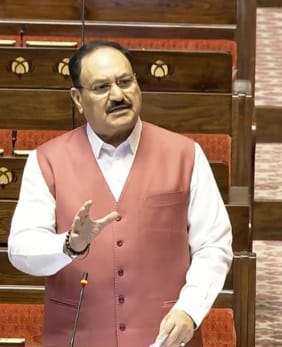
Union Health Minister Jagat Prakash Nadda on Tuesday said the government has taken significant steps to strengthen domestic pharmaceutical manufacturing and reduce dependence on imported raw materials under the leadership of Prime Minister Narendra Modi.
Replying to questions in the Rajya Sabha, Mr. Nadda said the Production Linked Incentive (PLI) scheme for bulk drugs, approved in 2020 with a financial outlay of ₹6,940 crore, is aimed at boosting domestic production of key pharmaceutical ingredients. The scheme focuses on manufacturing Key Starting Materials (KSMs), drug intermediates and Active Pharmaceutical Ingredients (APIs), and will remain operational until the financial year 2028-29.
The minister informed the House that over the past four years, 48 projects covering 33 bulk drugs have been approved under the scheme. These projects have drawn investments worth ₹4,814 crore, surpassing the originally committed ₹4,322 crore.
According to Mr. Nadda, the initiative has generated cumulative sales of ₹2,722 crore and exports valued at ₹528 crore, while helping the country avoid imports worth nearly ₹2,190 crore.
He noted that several bulk drugs which were earlier largely imported — including penicillin and clavulanic acid — are now being produced within the country. India has also begun exporting these medicines, reflecting growing domestic capacity.
The minister also highlighted the PLI scheme for pharmaceuticals approved by the Union Cabinet in February 2021 with a budget allocation of ₹15,000 crore. The scheme is designed to promote the manufacturing of high-value pharmaceutical products and strengthen India’s position in global pharmaceutical supply chains.
Mr. Nadda said the programme supports production of biopharmaceuticals, complex generic medicines, orphan drugs and patented drugs.
A total of 55 companies, including 22 from the MSME sector, have been selected under the scheme. The minister noted that investments under the initiative have reached ₹41,920 crore, significantly exceeding the initial commitment of ₹17,275 crore.
He said the scheme has already generated cumulative sales of ₹3.33 lakh crore and exports worth ₹2.14 lakh crore.
Mr. Nadda further stated that more than 190 APIs and drug intermediates are now being manufactured domestically for the first time, while the programmes together have created employment opportunities for over 1.12 lakh people.
The health minister added that the policy measures introduced since the outbreak of the COVID-19 in 2020 are aimed at expanding India’s pharmaceutical manufacturing capabilities, reducing reliance on imported bulk drugs and attracting large-scale investments.
He expressed confidence that by 2029, India will move much closer to achieving self-reliance in the production of APIs, drug intermediates and key starting materials.