
Last Updated on April 10, 2026 11:31 pm by BIZNAMA NEWS
By S. N. Verma

India receives an estimated 4,000 cubic kilometres of rainfall annually—equivalent to roughly one million gallons of freshwater per person each year. Yet despite this seemingly abundant resource, the country continues to grapple with severe water management challenges. Cycles of floods and droughts regularly affect large parts of the country, particularly the western and southern regions, where water shortages and erratic rainfall patterns often create hardships for farmers and rural communities.
In many areas, inadequate irrigation leads to crop failures, pushing vulnerable farmers into financial distress. Paradoxically, even though India receives heavy monsoon rainfall between July and September, several regions face acute drinking water shortages during other seasons. These stark regional disparities and the recurring flood–drought cycle have long highlighted the need for better water resource management, giving rise to the concept of linking major rivers across the country.
The idea of interlinking rivers in India is not new. During the British colonial era, 19th-century engineer Arthur Cotton proposed connecting major rivers to address drought and water scarcity in parts of southeastern India, particularly present-day Andhra Pradesh and Odisha. After independence, the concept resurfaced in the 1970s when irrigation expert Dr. K. L. Rao suggested creating a national water grid to redistribute water from flood-prone northern rivers to the drought-affected south.
Several studies and reports on river-linking projects were produced after the 1980s, though progress remained limited. The proposal gained renewed momentum in 1999 when the National Democratic Alliance government revived discussions on the National Perspective Plan for river interlinking.
However, the proposal has also faced strong criticism. When the United Progressive Alliance government came to power, reservations were raised regarding the project’s environmental and financial implications. Social activists and environmentalists warned that such massive engineering interventions could disrupt ecosystems, alter river flows and displace communities.
Between 2005 and 2013, the central government set up several expert committees to examine the feasibility and potential impacts of river interlinking projects. In February 2012, while hearing a public interest litigation filed earlier, the Supreme Court of India declined to issue directions for implementing the project, stating that it involved complex policy decisions within the domain of the executive and legislative authorities.
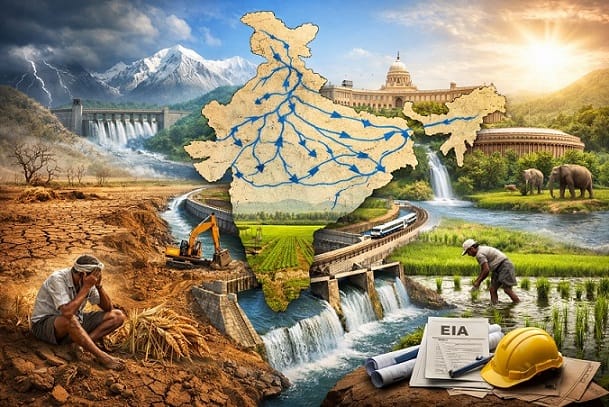
Before any river link project proceeds, authorities conduct a comprehensive Environmental Impact Assessment as part of feasibility and detailed project reports. These studies evaluate environmental, ecological and socio-economic impacts on communities living along river basins. Necessary environmental and wildlife clearances must also be obtained under existing laws.
Currently, feasibility reports have been completed for 26 river links, while detailed project reports are ready for 13 out of the 30 proposed links under the National Perspective Plan for Interlinking of Rivers. Notably, none of these projects involve the Union Territory of Jammu and Kashmir.
Among the major projects sanctioned in recent years are the Godavari–Krishna River Link, Krishna–Pennar Link, Bedati–Varda Link, Netravati–Hemavati Link, and the Ken–Betwa River Linking Project. Of these, the Ken–Betwa link is the first priority project to have moved into the implementation phase.
India’s river-linking framework broadly consists of two components: Himalayan rivers and Peninsular rivers. The Himalayan component envisions constructing large storage reservoirs on major rivers such as the Ganga and Brahmaputra, along with interconnected canal systems to transfer surplus water from eastern tributaries to water-deficient western regions. The proposal also includes cooperation with neighbouring countries such as Nepal and Bangladesh, provided suitable water-sharing agreements can be reached.
The Peninsular component focuses on linking rivers across central and southern India, including projects involving the Mahanadi, Godavari, Krishna, Pennar, Cauvery, Narmada, and Tapi rivers.
Overall, while the Ken–Betwa project marks the first tangible step toward implementing India’s ambitious river interlinking vision, most proposed links remain at the planning stage. With feasibility and detailed reports gradually progressing, the future of the programme will depend on balancing water security needs with environmental sustainability and inter-state cooperation.