
By ANDALIB AKHTER
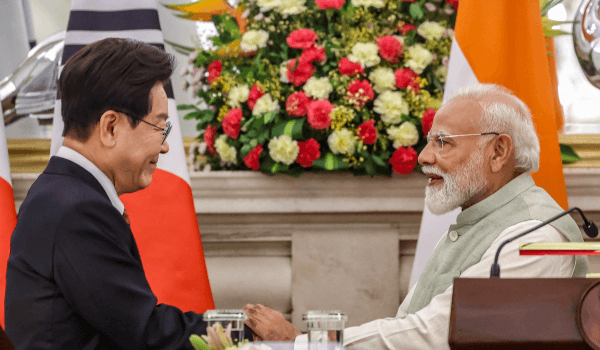
Prime Minioster Narendra Modi on Monday signalled a major upgrade in economic engagement with South Korea, outlining a roadmap to transform bilateral ties into a “futuristic partnership” anchored in trade, technology, and industrial collaboration. The announcement came during talks with President Lee Jae Myung in New Delhi, marking the first high-level visit between the two nations in eight years.
At the core of the renewed partnership is an ambitious plan to nearly double bilateral trade from the current $27 billion to $50 billion by 2030. Both sides agreed to fast-track this goal through an upgraded trade agreement and new institutional mechanisms aimed at easing investment flows and strengthening supply chain resilience.
To deepen financial and industrial linkages, the two countries will launch an India-Korea Financial Forum, an Industrial Cooperation Committee, and an Economic Security Dialogue. These platforms are expected to drive collaboration in critical sectors such as semiconductors, advanced manufacturing, and strategic technologies—areas seen as vital for future economic competitiveness.
A key highlight is the proposed Korean Industrial Township in India, designed to attract investments, particularly from small and medium enterprises. This move is expected to enhance manufacturing integration, boost exports, and create jobs, while positioning India as a regional hub for Korean companies.
Technology-led growth will form another pillar of the partnership, with the launch of the India-Korea Digital Bridge focusing on artificial intelligence, semiconductors, and IT ecosystems. In addition, multiple agreements across shipbuilding, steel, ports, and sustainability sectors underscore a broad-based push to align industrial capabilities.
Beyond trade, both nations are looking to strengthen cooperation in clean energy and climate initiatives, with Seoul backing frameworks such as the International Solar Alliance. The partnership also aligns with broader Indo-Pacific economic strategies, signalling closer coordination on regional supply chains and infrastructure development.
The reset in ties reflects a strategic convergence where economic priorities—ranging from technology partnerships to resilient supply chains—are increasingly shaping diplomatic engagement. For India, deeper integration with Korea’s industrial and innovation ecosystem supports its long-term growth ambitions, while for Korea, India offers a large market and a critical manufacturing base in an evolving global trade landscape.