

By Santosh Kumar Pathak
The events of April 24 may well remain one of the most defining—and unsettling—moments in the political journey of Arvind Kejriwal. On the very day the Aam Aadmi Party (AAP) chief shared on social media that he had shifted into a government-allotted residence with his family—secured after a prolonged legal battle—his own party faced a dramatic internal rupture. Trusted Members of Parliament delivered what can only be described as a political shock by breaking ranks and weakening the party from within.
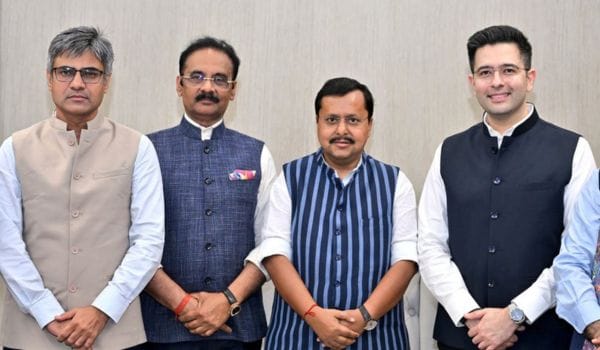
In a striking turn of events, leaders such as Raghav Chadha and Sandeep Pathak—who had been elevated by Kejriwal as prominent faces of the party, often at the expense of veterans from the movement era—played a pivotal role in this split. Their exit not only dealt a blow to Kejriwal’s leadership but also severely undermined AAP’s strength in the Rajya Sabha.
Ironically, Chadha’s political rise had once been championed by leaders like Kumar Vishwas, Sanjay Singh, and Kejriwal himself, who had inducted him into the party as an intern. Demonstrating the very political acumen that once earned him recognition, Chadha reportedly orchestrated the defection of seven out of AAP’s ten Rajya Sabha MPs—meeting the two-thirds threshold required under anti-defection laws—and aligned with the Bharatiya Janata Party (BJP). While this move reaffirmed his strategic capabilities, it also positioned him in direct opposition to his former political mentor.
Before their departure, the dissenting leaders accused the party of straying from its founding principles, claiming that the organization they had nurtured with “blood and sweat” had lost its ideological direction. In response, Kejriwal, staying true to his combative political style, accused the BJP of betraying the Punjabi community. Meanwhile, AAP’s internal machinery has reportedly launched a campaign branding the defectors as traitors, even going so far as to question their loyalty to the nation.
However, rather than resorting to political vilification, the situation arguably calls for introspection. AAP’s leadership—especially those who were part of its formative anti-corruption movement—must reassess the party’s trajectory. Since its inception around 2013, several key leaders have exited the party at different junctures. A serious evaluation of who left, when, why, and under what circumstances is long overdue. Yet, instead of fostering internal debate, the tendency to label every departing leader as a traitor risks suppressing legitimate questions about leadership style and organizational functioning.
Born out of a nationwide anti-corruption movement, AAP once symbolized an alternative political culture. Its potential decline, therefore, could have broader implications, possibly discouraging future grassroots movements in the country. Attributing the crisis solely to external factors such as alleged “Operation Lotus” or the BJP’s political maneuvering may not fully address the deeper structural and leadership challenges within the party.
At this critical juncture, senior leaders like Sanjay Singh and Manish Sisodia must take the initiative to convene an emergency meeting of the party’s national executive and implement decisive reforms. Questions that were once overlooked now demand urgent answers. For instance, despite the principle of “one person, one post,” why has Kejriwal continued as the party’s national convener for over thirteen years? Does the party lack alternative leadership capable of steering its future?
Equally important are concerns regarding centralized decision-making. Whether it is expelling leaders or selecting Rajya Sabha candidates, how long can such critical decisions remain concentrated in the hands of a single individual? What role does the Political Affairs Committee actually play, and why has it not emerged as a meaningful decision-making body?
The party’s recent electoral setback in Delhi further complicates matters. Instead of rebuilding its base in the capital or expanding organizational efforts across other states, several leaders appear to be gravitating toward Punjab—a state where AAP remains in power. This raises uncomfortable questions about political commitment and organizational resilience. Should leaders not demonstrate the willingness to rebuild and struggle on the ground, even after electoral defeat?
If these issues remain unaddressed, the risk of further fragmentation—or even a complete organizational collapse—cannot be ruled out. In a worst-case scenario, AAP’s remaining structure could face gradual absorption into rival political formations.
If the crisis is indeed the result of the inflexibility of one or two individuals, then the party leadership must collectively consider transitioning authority to a more broadly accepted and capable figure. Additionally, AAP should actively pursue the return of its former leaders and reconnect with its original cadre. Most importantly, the party must revisit its candidate selection process, ensuring that positions such as Rajya Sabha nominations are granted based on dedication and grassroots work rather than financial or elite considerations.
India’s political landscape is evolving rapidly. Unless AAP adapts even more swiftly, it risks not only losing its relevance but also jeopardizing its identity and electoral symbol. The pressing question remains: are leaders like Arvind Kejriwal, Manish Sisodia, Sanjay Singh, Bhagwant Mann, and Atishi Marlena prepared to undertake the sweeping changes required to salvage the party’s future?