
Indian Capital Markets Mobilise Nearly ₹9 Lakh Crore in Seven Months; SEBI Plans FPI Reforms
STAFF REPORTER
India’s capital markets are emerging as a major financing engine for the economy, mobilising nearly ₹9 lakh crore in just seven months of the current financial year as market capitalisation crosses the $5-trillion mark. With more than 15 crore unique investors participating in the securities market, the growing fundraising momentum is prompting the Securities and Exchange Board of India (SEBI) to push a fresh round of regulatory reforms aimed at attracting foreign capital, easing compliance and deepening market access.
The report highlights two major developments in India’s capital markets: record-scale fundraising and a push to make foreign investment easier through regulatory simplification. The story is best structured around the ₹9 lakh crore mobilisation, growing IPO and bond markets, and SEBI’s proposed reforms for foreign portfolio investors, while retaining the key figures and policy details.
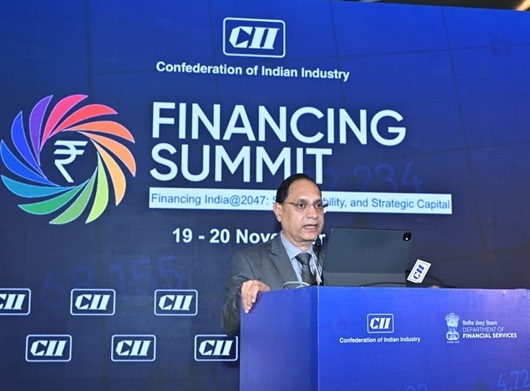
SEBI Chairman Tuhin Kanta Pandey, addressing the CII-DFS Financing Summit 2026 in Mumbai Thursday, said Indian companies had raised an average of around ₹10 lakh crore annually through equity and debt instruments over the past decade, supported by economic growth, wider investor participation and regulatory improvements.
The securities market now has more than 15 crore unique investors, reflecting the broadening of India’s investment base beyond traditional institutional and wealthy investors.
IPO market maintains strong momentum
The primary market continues to play an important role in mobilising capital for businesses. Pandey said 235 companies had raised approximately ₹1.5 lakh crore through initial public offerings (IPOs) so far in the current financial year, underlining the continued appetite for equity fundraising and the growing role of capital markets in corporate expansion.
The sustained activity in IPOs also reflects the increasing willingness of companies to tap public markets for growth capital, while offering investors opportunities to participate in businesses across sectors.
Corporate bonds emerge as a major financing channel
India’s corporate bond market is steadily expanding as businesses diversify their funding sources beyond bank loans. Outstanding corporate bonds stood at nearly ₹62 lakh crore in August, equivalent to around 55 per cent of bank credit extended to the industrial and services sectors.
Companies have already raised more than ₹5 lakh crore through corporate bond issuances during FY 2026-27, highlighting the growing importance of debt markets in financing business expansion, infrastructure development and long-term investment.
The expansion of the bond market is also significant for reducing excessive dependence on bank-based financing and creating a broader financial ecosystem capable of meeting the diverse funding requirements of businesses.
Alternative investments and infrastructure financing gain ground
Alternative Investment Funds (AIFs) are increasingly contributing to the financing of emerging businesses and investment opportunities. Their cumulative investments reached approximately ₹7.5 lakh crore by September, while committed capital exceeded ₹18 lakh crore, reflecting the growing pool of funds available for alternative investments.
Meanwhile, assets managed by Real Estate Investment Trusts (REITs) and Infrastructure Investment Trusts (InvITs) have crossed ₹10 lakh crore. These investment vehicles are playing a growing role in infrastructure financing, allowing investors to participate in income-generating property and infrastructure assets while helping developers and asset owners recycle capital into new projects.
SEBI moves to ease foreign investor entry
Attracting foreign portfolio investment remains a key regulatory priority. Pandey said SEBI would soon issue a consultation paper proposing further simplification of procedures for Foreign Portfolio Investors (FPIs), including removing certain compliance requirements that are not commonly followed in other major international markets.
The regulator is working to reduce the FPI registration and onboarding process to as little as five business days. Around 740 foreign portfolio investors have registered under the Swagat framework, accounting for 17 per cent of total FPI assets under custody.
SEBI has already introduced several measures to ease procedures, including digital onboarding, digitally signed powers of attorney and net settlement facilities aimed at lowering funding costs.
From December 1, applicable FPI KYC review cycles will be extended from one and three years to two and eight years, respectively. Eligible non-resident Indians (NRIs), overseas citizens of India (OCIs) and foreign nationals will also be able to complete KYC and re-KYC procedures digitally without travelling to India.
Regulatory modernisation and investor protection
SEBI is also reviewing the Issue of Capital and Disclosure Requirements (ICDR) and Listing Obligations and Disclosure Requirements (LODR) frameworks to eliminate duplicate corporate filings and introduce a single-fine mechanism.
Other priorities include working with the Reserve Bank of India and the Finance Ministry on a corporate bond market-making framework, reducing REIT and InvIT listing timelines to three working days and expanding the use of artificial intelligence in regulatory operations.
On investor protection, Pandey highlighted disaster-recovery requirements involving a 45-minute recovery mandate, SEBI Check, validated UPI handles and the nationwide ‘Samajh Se Investing Simple’ awareness campaign.
The initiatives reflect SEBI’s dual approach of expanding market access and strengthening investor safeguards as India’s capital markets grow in scale, deepen their financing capacity and attract greater domestic and international participation.