
– By Lalit Gargg
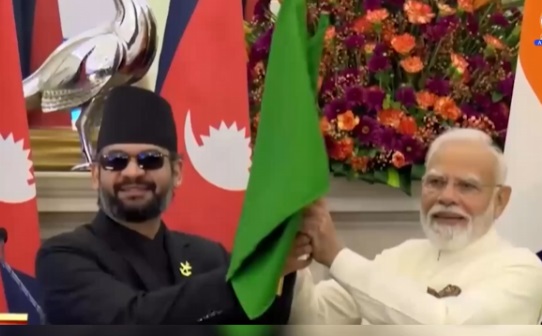
Nepal Prime Minister Balen Shah’s visit to India on November 22–23, 2026, is far more than a routine diplomatic engagement. It signals the possibility of a new beginning in India–Nepal relations. Since assuming office in March, this is his first bilateral visit to any country, and his first destination is India. Although he travelled to the United States in September to attend the United Nations General Assembly, that was not a bilateral state visit. His decision to choose New Delhi for his first bilateral engagement therefore carries considerable diplomatic significance. The visit is particularly important because Nepal’s foreign policy appeared to acquire some new nuances after Balen Shah came to power. Some of his earlier remarks concerning India had caused unease, while Nepal’s economic and strategic engagement with China continued to grow. But foreign policy is shaped by both enduring friendships and temporary differences. “Better late than never”—Balen Shah’s arrival in New Delhi appears to reaffirm that sentiment.
India, too, has never shut the door on Nepal. Following the devastating floods in August, India extended emergency assistance, relief material and technical support to Nepal. This was more than humanitarian assistance; it conveyed a larger message—that in times of crisis, the immediate neighbour is often the first to stand by you. India–Nepal relations are not merely the product of diplomatic agreements. They are rooted in centuries-old civilisational, cultural and social ties—an open border, religious and cultural affinity, marriage relations, linguistic connections and a shared pilgrimage tradition. Janakpur and Ayodhya, Pashupatinath and Kashi, Lumbini—the birthplace of the Buddha—and India’s rich Buddhist heritage are not merely tourist destinations; they are landmarks of a shared civilisational consciousness.
Yet in today’s world, the traditional “roti-beti” relationship alone is not enough. Emotions have their place, but economic interests, technology, energy, security and connectivity have become the new language of international partnerships. India–Nepal relations therefore need to move beyond their emotional inheritance and evolve into a comprehensive economic and strategic partnership. That is the need of the hour. Nepal needs capital, technology, employment opportunities, energy markets and better connectivity for its development. India has the capacity to contribute in all these areas. At the same time, India needs a stable, prosperous and friendly Nepal. The fundamental interests of the two countries are therefore more complementary than conflicting.
Balen Shah’s decision to visit India is itself a diplomatic message. His predecessor, K.P. Sharma Oli, chose China for his first official foreign visit, departing from the older informal convention. Balen Shah’s decision to begin with India does not mean that Nepal is distancing itself from China. But it does indicate that New Delhi retains a natural and important place in Kathmandu’s foreign-policy calculus. Nepal today seeks to maintain a balance between India and China. This is also a consequence of its geography and economic realities. India must understand this rather than attempt to push Nepal into any particular camp. The wiser strategy would be to build a partnership in which Nepal retains an independent foreign policy while gaining more choices for its development. This is the real test of Indian diplomacy: India must convince Nepal that it does not restrict its choices—it expands them.
During Balen Shah’s visit, Nepal has sought nearly $2 billion in grants and concessional assistance from India. New Delhi has shown a positive inclination toward Nepal’s economic proposals, although the final package and its structure remain under discussion. The issue of additional air routes is also yet to be fully resolved. This is precisely where India needs to adopt a fresh approach. Nepal does not merely need assistance; it needs India to become a long-term partner in projects that can strengthen the foundations of its economy and enhance self-reliance. Hydropower is the most compelling example. Nepal possesses enormous hydropower potential, while India’s demand for clean energy is rising rapidly. The two countries can create a mutually beneficial model through long-term power trade, transmission infrastructure and new hydropower projects—Nepal generates electricity, India provides the market, and both countries prosper.
The target of long-term electricity trade of up to 10,000 MW between India and Nepal is an important step in this direction. The Pancheshwar project, Lower Arun, cross-border electricity connectivity and new energy corridors cannot remain trapped in files of unresolved differences. “It is never too late to make a fresh start.” The time has come for both countries to move long-pending projects from the realm of promises to the ground of implementation. The next major chapter of India–Nepal relations should be connectivity. Railways, roads, pipelines, digital networks and air links are the new arteries of modern diplomacy. The launch of the Ayodhya–Janakpur rail connection today is significant not only culturally but also from the perspective of tourism and people-to-people contact. The proposed Raxaul–Kathmandu railway could eventually transform trade and passenger movement. Integrated check posts, energy pipelines and expanded trade corridors can further bind the economies of the two countries.
Nepal’s demand for additional Indian air routes for airports such as Bhairahawa and Pokhara is also significant. Practical solutions must be found while keeping security, technical requirements and airspace considerations in mind. At the same time, sensitive issues cannot simply be wished away. The Kalapani, Lipulekh and Limpiyadhura boundary disputes remain difficult realities in bilateral relations. The review of the 1950 India–Nepal Treaty, recruitment of Gorkha soldiers, trade imbalance and disagreements surrounding projects such as Pancheshwar have also periodically generated friction. These issues must neither be ignored nor allowed to dominate every bilateral meeting. The way forward is dialogue, facts, sensitivity and political maturity.
Any discussion of India–Nepal relations are incomplete without considering China. Nepal is also cooperating with China in roads, energy, connectivity and Belt and Road-related projects. India should not view this exclusively through the prism of geopolitical competition. It must understand Nepal’s aspirations for development. India’s most effective strategy would be to tell Nepal: “Your path of development is yours to choose, but India will remain your reliable neighbour and partner along that journey.” India must demonstrate through its actions that its partnership with Nepal in democracy, development, employment, education, healthcare, digital economy and energy is designed for the long term. Trust is not created by power or pressure; it is built through conduct.
India’s “Neighbourhood First” policy now needs a broader and more ambitious dimension. Relations with neighbouring countries should not remain confined to aid and political engagement; they should be anchored in platforms for shared economic growth. One possible approach would be to develop a new multilateral framework involving India, Nepal, Bhutan, Bangladesh, Sri Lanka and the Maldives for cooperation in shared development, disaster management, energy, digital connectivity and trade. Excluding Pakistan, such a framework among willing neighbours could enhance India’s positive influence across South Asia.
This need not be a military alliance. It could instead become an alliance for development and human security—where electricity, water, roads, railways, digital payments, disaster relief, healthcare, education and tourism become instruments of shared prosperity. Nepal could become the natural starting point for such a model. A new economic corridor stretching from the Himalayas to the Bay of Bengal could connect Nepal’s hydropower resources with India’s vast market and Bangladesh’s growing energy needs. Such integration could provide a powerful new impetus to the regional economy. Balen Shah’s Delhi visit should therefore not merely be an opportunity to reset relations; it should be an opportunity to reimagine them.
A new voice is emerging from the heights of the Himalayas—a voice calling for partnership, prosperity and shared security. If the aspirations of Nepal’s new generation under Balen Shah connect with Prime Minister Narendra Modi’s Neighbourhood First vision, India–Nepal relations could emerge as a new model of cooperation in South Asia. As the saying goes, “One and one make eleven.” If India and Nepal combine their strengths, they can achieve far more together than either can accomplish alone. From Delhi to Kathmandu, it is not merely a breeze of friendship that should flow, but a new wind of development, opportunity and shared prosperity. That should be the defining strategic vision for the next chapter of India–Nepal relations.