
Experts question World Bank methodology, highlight income inequality, poor-quality jobs and uneven access to economic opportunities
Andalib Akhter / NEW DELHI
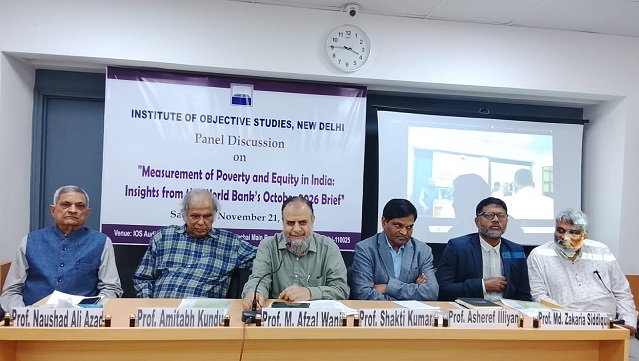
Despite a significant decline in poverty over the past decade, India continues to face deep-rooted economic inequalities, with wealth and income concentrated in a small section of the population, leading economists and academics warned at a panel discussion organised by the Institute of Objective Studies (IOS) here on Saturday.
The discussion, titled ‘Measuring Poverty and Equity in India: Insights from the World Bank’s October 2026 Brief’, examined the methodology used to measure poverty, the quality of employment, unequal distribution of resources and the sustainability of poverty reduction.
The World Bank’s October 2026 India Poverty and Equity Brief estimates that the proportion of Indians living below the lower-middle-income poverty line of $4.20 per person per day (2021 purchasing power parity) declined from 57.7 per cent in 2011 to 16.1 per cent in 2023. Extreme poverty, measured against the international benchmark of $3 per person per day, fell from 27.1 per cent to 2.6 per cent during the same period.
However, the panellists cautioned against interpreting these figures as evidence of equitable economic development. They pointed out that the average income of workers in the top 10 per cent of the income distribution was nearly 13 times that of workers in the bottom 10 per cent in 2023.
Professor Amitabh Kundu, Professor Emeritus at LJ University, Ahmedabad, questioned whether the decline in poverty had translated into better employment, higher real wages and a fairer distribution of economic resources. He also highlighted discrimination faced by minorities, particularly Muslims, in accessing employment, observing that such discrimination was more pronounced in urban areas.
Kundu also questioned the poverty measurement framework, arguing that government transfers and welfare assistance included in household income calculations needed closer scrutiny when assessing people’s actual economic conditions.
Professor Shakti Kumar of the Centre for Economic Studies and Planning, Jawaharlal Nehru University, raised concerns about the comparability of the National Household Survey data used for the 2011 and 2023 assessments. He questioned whether the findings adequately reflected India’s varying daily wage rates across states and sectors.
He pointed out that even people officially considered to have moved above the poverty line may continue to earn substantially less than the prevailing minimum daily wage. He also highlighted the concentration of poverty in eastern and northern states, particularly the belt stretching from Uttar Pradesh to West Bengal, and the substantially higher incidence of rural poverty.
Professor Ashraf Azeem of Jamia Millia Islamia questioned the claim of improving living standards against the backdrop of reduced public spending on essential sectors such as education and healthcare. He cited estimates suggesting that 10 per cent of the population controls 42 per cent of the country’s wealth.
He argued that providing free facilities alone cannot offer a lasting solution to poverty and stressed the need for sustainable employment and regular incomes.
Professor Naushad Ali Azad, former Dean of the Faculty of Social Sciences at Jamia Millia Islamia, emphasised the need to address the employment challenges confronting young people entering the labour market. He called for greater investment in productive jobs, vocational and higher education, labour-intensive industries and employment opportunities for women.
Professor Zakaria Siddiqui also stressed that rising workforce participation did not necessarily translate into improved household incomes or economic security, particularly given informal employment, low productivity, inadequate wages and the absence of social protection.
Presiding over the discussion, IOS Chairman Professor M Afzal Wani said the World Bank’s assessment offered a reassuring picture, but India remained far from fulfilling the constitutional commitments made to the poor and working classes.
The panellists broadly agreed that poverty reduction must go beyond statistical improvements and focus on decent employment, fair wages, equitable wealth distribution and access to quality education, healthcare and economic opportunities.