
Last Updated on June 23, 2026 4:28 pm by BIZNAMA NEWS
— Lalit Gargg
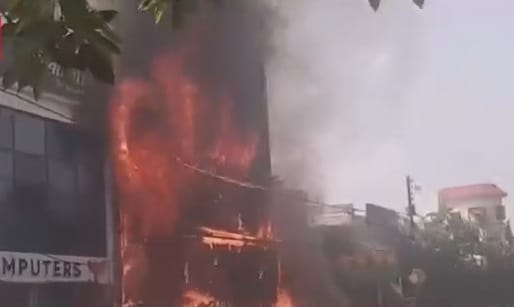
The devastating fire that engulfed a commercial building in the Aliganj area of Lucknow, the capital of Uttar Pradesh, did not merely consume a structure; it exposed the insensitivity of the administration, the inertia of regulatory institutions, and the hollow accountability of a system that has steadily lost its moral compass. The untimely deaths of several students in a coaching centre housed in the building have shaken the entire nation. This was not merely an accident; it was the inevitable outcome of a decaying system that springs into action for a few days after every tragedy, only to lapse once again into deep slumber.
From the fire at the gaming zone in Rajkot, the deaths of newborns in a Delhi hospital, the Delhi hotel fire, the Muzaffarpur hospital tragedy, and now the Lucknow inferno, this unending chain of disasters reveals a disturbing reality: in India, the value of human life appears to be diminishing alarmingly. After every such tragedy, the same familiar statements are heard: “The guilty will not be spared,” “An inquiry has been ordered,” “Strict action will be taken.” But the pertinent question is: Is ordering inquiries and distributing compensation the government’s ultimate responsibility? Are governments meant only to express grief and announce ex gratia payments after disasters strike? These deadly flames have extinguished the lamps of countless homes, robbed many families of their hopes and dreams, and smeared the faces of those responsible for law and governance with the soot of failure.
The building in Lucknow where the fire broke out housed coaching centers and several other commercial establishments. This raises serious questions. Did the building possess a valid No Objection Certificate (NOC) from the Fire Department? Were prescribed building and fire safety norms followed? Were emergency exits available? If they existed, why could they not be effectively used? And if they did not exist, how did the administration fail to notice such glaring violations for so long? This is not merely a case of negligence on the part of the building owner. If a commercial establishment can continue to operate for years while violating safety norms, it clearly indicates either the silent consent of the administrative machinery or a nexus of corruption. What, then, is the role of municipal corporations, development authorities, fire departments, and local administrations? Is their responsibility confined merely to issuing licences and conducting perfunctory inspections? Or have they become complicit in concealing deficiencies while filling their own pockets?
The harsh reality is that public safety in most Indian cities remains largely a matter of chance. Skyscrapers continue to rise, but their compliance with safety standards remains deeply questionable. Many multistoried buildings have only a single entry and exit point. Fire-fighting equipment is either absent or has remained non-functional for years. Regular mock drills for disaster preparedness are virtually nonexistent. Buildings routinely accommodate far more people than their sanctioned capacity. Although safety provisions may exist in rulebooks, their implementation on the ground is negligible.
Perhaps the most tragic aspect of this paradox is that every major accident is followed by the formation of inquiry committees and the preparation of detailed reports, yet these reports rarely translate into meaningful action. From the Uphaar Cinema fire tragedy to Rajkot and now Lucknow, the nation has repeatedly vowed to learn lessons, but the system has learned nothing. Administrative memory has become painfully short-lived. For a few days, inspections, raids, and notices create an illusion of activity; thereafter, everything reverts to business as usual. This situation reflects not merely administrative inefficiency but also profound moral decay. Corruption has hollowed out the very soul of our safety mechanisms. Inspecting officials often choose to turn a blind eye in exchange for illicit benefits, while building owners, driven by profit, neglect essential safety measures. The result is that innocent citizens lose their lives.
A larger question also demands attention: Is our urban development truly human-centric? We speak proudly of Smart Cities, metro cities, and world-class urban centres, but if citizens cannot feel safe within them, what meaning does such development hold? The foremost hallmark of any civilized society is the safety and security of its people. If coaching centres, hospitals, hotels, malls, and other public spaces are unsafe, then our entire development model warrants serious reconsideration. Today, the need is not merely to identify culprits but to undertake comprehensive structural reforms. First, an independent nationwide safety audit of all commercial buildings, coaching institutes, hospitals, malls, hotels, and public establishments must be conducted. Institutions lacking fire safety certificates or failing to comply with prescribed standards should be shut down immediately.
Second, fire departments must be equipped with modern technology, adequate infrastructure, and sufficient manpower. Numerous reports indicate an acute shortage of fire stations and trained personnel across the country. Given the rapid pace of urbanization, expanding and strengthening fire services has become imperative. Third, mandatory mock drills should be conducted every six months in all public buildings. Disaster management training should form an integral part of school, college, and coaching institute curricula so that people learn to respond calmly and effectively during emergencies rather than succumbing to panic. Fourth, a clear framework of accountability must be established. Punitive action should not be limited to building owners alone; officials responsible for negligence, dereliction of duty, or deliberate disregard of regulations must also face stringent consequences. Unless public officials are held personally accountable, meaningful reform will remain elusive.
Most importantly, governance priorities must shift from post-disaster response to pre-disaster prevention. Good governance is not merely about formulating schemes and policies; it is equally about safeguarding the lives of citizens. The true measure of administrative success lies not in the amount of compensation distributed after tragedies, but in the ability to prevent such tragedies from occurring in the first place. Local administrations should have complete awareness of how coaching centers, hospitals, factories, hotels, and other establishments within their jurisdictions are functioning, and whether they are complying with legal and safety requirements. The pressing question remains: How can these recurring and brutal disasters be brought to an end?
Navigating the turbulent river of accidents and ensuring that the boat of human life reaches its destination safely is an immense challenge—not only for governments but also for society at large. In pursuit of profit, individuals often become so dishonest and unscrupulous that they gamble with thousands of lives and livelihoods. The prosperity of a few families comes at the cost of devastating countless others. Such tragedies are often rooted in systemic lethargy and criminal negligence, nurtured by corruption, bureaucratic indifference, greed, and blatant violations of laws and regulations. Why is it that wherever the risk of disaster is greatest, safety mechanisms appear weakest? Why are laws and regulations most flagrantly violated precisely where they are needed the most?
As life grows increasingly fast-paced, safety seems to diminish proportionately. Even as governments speak of vigilance, evidence of administrative negligence continues to mount. The death toll rises, yet every major tragedy, after a brief period of public outrage, merely waits to be overshadowed by the next disaster. If governments and administrative agencies were to demonstrate the same urgency in ensuring safety measures as they do in announcing compensation and constituting inquiry committees, the frequency of such tragedies could be significantly reduced.
The Lucknow fire is a warning. If governance and administration fail to awaken even now, future tragedies may assume even more horrific proportions. This is a moment for deep introspection, for if every inferno leaves behind nothing but ashes and the system invariably returns to its old ways, then such negligence amounts to nothing less than an institutional crime. What the nation needs today is not merely sympathy, but a robust system; not inquiries, but accountability; not assurances, but decisive action. Otherwise, after every fire, the same haunting question will continue to echo: When will the system finally awaken?