
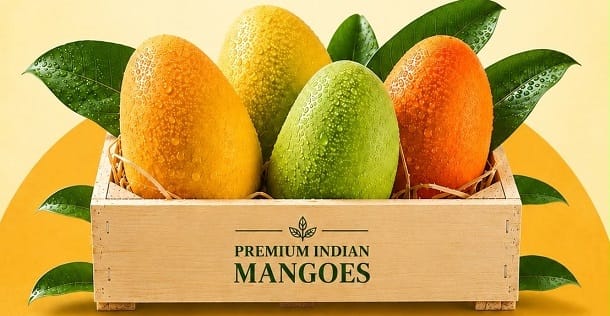
Last Updated on June 29, 2026 1:13 am by BIZNAMA NEWS
India’s mango industry is entering a new phase.
By ANDALIB AKHTER
For decades, the country has comfortably retained its position as the world’s largest producer of mangoes, accounting for nearly half of global output and cultivating hundreds of varieties across states such as Uttar Pradesh, Andhra Pradesh, Telangana, Maharashtra, Gujarat, Bihar, Karnataka and Madhya Pradesh. Mangoes are deeply woven into India’s agricultural economy, providing livelihoods to millions of farmers and supporting an extensive value chain of traders, processors, exporters and logistics providers.
Yet, despite its unmatched production capacity, India has never fully translated its dominance in cultivation into leadership in the global export market.
The reasons are well known. A large proportion of India’s annual production is consumed domestically, leaving relatively limited exportable surplus. In addition, strict phytosanitary regulations, fragmented supply chains, inadequate cold-chain infrastructure, high air-freight costs and inconsistent quality standards have historically restricted the country’s ability to compete with exporters such as Peru, Mexico, Thailand, Brazil and Pakistan in premium overseas markets.
Recognising these challenges, the Government of India has gradually shifted its strategy from simply increasing agricultural production to building globally competitive agricultural brands. In the mango sector, that transformation is being led by the Agricultural and Processed Food Products Export Development Authority (APEDA), which has expanded its role far beyond export promotion.
Today, APEDA works closely with state governments, Farmer Producer Organisations (FPOs), exporters, research institutions and international buyers to improve every stage of the export ecosystem—from scientific cultivation and post-harvest management to quality certification, modern pack houses, irradiation facilities, cold-chain logistics and overseas market promotion.
The objective is not merely to sell more mangoes abroad. It is to position Indian mangoes as premium products capable of commanding higher prices in international markets while ensuring that the additional value reaches farmers.
Recent developments suggest that the strategy is beginning to deliver results.
Within weeks, India achieved several milestones that illustrate the changing direction of its mango export programme. The country exported the first commercial shipment of GI-tagged Rewa Sundarja mangoes from Madhya Pradesh to the United Arab Emirates, dispatched the first sea-borne commercial consignment of Banganapalli mangoes to Singapore, introduced premium Indian varieties in Iceland through a dedicated promotional campaign, and showcased its finest mangoes before American consumers during the annual Mango Festival in Washington.
Taken individually, these events may appear routine export announcements. Viewed together, however, they represent a broader effort to diversify markets, reduce logistics costs, strengthen regional branding and create long-term demand for Indian mangoes across the world.
Among the most significant achievements was the commercial export of Rewa Sundarja, a Geographical Indication (GI)-tagged variety from Madhya Pradesh renowned for its sweetness, aroma and fibre-free pulp.
For growers, the export offered more than international recognition—it delivered tangible economic benefits. While domestic wholesale prices ranged between ₹100 and ₹110 per kilogram, export buyers paid around ₹150 per kilogram, increasing farmers’ earnings by nearly ₹40 to ₹50 per kilogram. The success demonstrated how branding, traceability and quality certification can translate directly into higher farm incomes.
Another breakthrough came from Andhra Pradesh, where APEDA facilitated the first commercial shipment of five metric tonnes of Banganapalli mangoes to Singapore by sea.
Traditionally, India’s premium mango exports have relied on air freight, making transportation expensive and limiting shipment volumes. Sea freight significantly reduces logistics costs, enables larger consignments and lowers carbon emissions. Supported by scientific post-harvest management, temperature-controlled logistics and modern packaging, the mangoes reached Singapore while maintaining their quality, sweetness and shelf life.
For farmers, the economic gains were equally significant. Mangoes that fetched around ₹25–26 per kilogram in domestic markets were reportedly exported at nearly ₹50 per kilogram, almost doubling growers’ returns.
India is also widening its geographical footprint.
As part of efforts to enter non-traditional markets, APEDA and the Embassy of India organised dedicated promotional events in Iceland, introducing consumers to premium Indian varieties such as Dasheri, Chausa, Langra and Kesar. Although Iceland is a relatively small importer, the initiative is strategically important because it opens opportunities in Northern Europe at a time when India is strengthening commercial engagement with countries of the European Free Trade Association (EFTA).
The country’s branding efforts have also reached the United States.
The Embassy of India in Washington, in collaboration with APEDA, the Department of Commerce and the Dupont Circle Business Improvement District, recently organised the annual Mango Festival, where hundreds of visitors sampled premium Indian varieties including Alphonso, Kesar, Dasheri, Langra and Banganapalli. Many visitors expressed interest in seeing Indian mangoes become more widely available in American retail stores.
Indian Ambassador to the United States Vinay Mohan Kwatra said the festival has evolved into a major annual attraction and highlighted the steady growth of Indian mango exports to the US through APEDA-supported export infrastructure and approved irradiation facilities.
The Washington festival illustrates that India’s mango strategy is no longer confined to exports alone. It is increasingly about building consumer awareness, strengthening the “Brand India” identity and creating sustained demand in high-value international markets.
For India, the challenge ahead is not producing more mangoes—it already leads the world in production. The real opportunity lies in exporting more premium-quality fruit, expanding into new markets and ensuring that greater value flows back to the country’s millions of mango growers. If the current strategy succeeds, India’s “King of Fruits” could become one of the country’s most successful agricultural export brands in the years ahead.