
By Zakir Hossain / Agencies
DHAKA/BEIJING: China has proposed the development of a new economic corridor connecting Bangladesh, Myanmar and China, underscoring Beijing’s efforts to strengthen regional connectivity, trade integration and cross-border infrastructure cooperation in South and Southeast Asia.
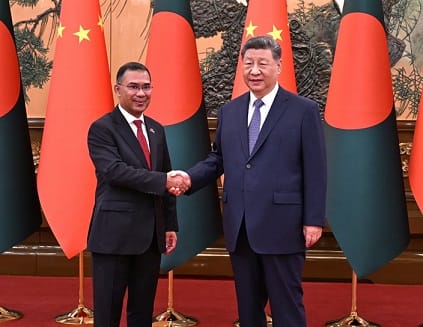
The proposal was discussed during talks between Chinese President Xi Jinping and Bangladesh Prime Minister Tarique Rahman at the Great Hall of the People in Beijing on Friday, according to Bangladesh Prime Minister’s Office (PMO).
PMO spokesperson Mahdi Amin said the two leaders held detailed discussions on regional connectivity, with particular emphasis on the potential establishment of a trilateral economic corridor linking Bangladesh, Myanmar and China.
“The proposal focuses on expanding Bangladesh’s economy, facilitating greater trade and economic transactions, and strengthening multimodal transport connectivity across the region,” Mahdi told reporters following the meeting. He added that the initiative could create new opportunities for regional commerce, investment flows and logistics integration.
If implemented, the proposed corridor would further complement China’s broader regional connectivity strategy while providing Bangladesh with enhanced access to regional markets through improved transport and trade infrastructure. The proposal also comes at a time when Dhaka is seeking greater foreign investment to accelerate industrial growth and export diversification.
Broad Economic Agenda
The Xi-Rahman meeting formed the centrepiece of the Bangladeshi Prime Minister’s four-day official visit to China and followed extensive bilateral discussions with Chinese Premier Li Qiang a day earlier.
According to Bangladeshi officials, the leaders reviewed cooperation across trade, investment, infrastructure development, connectivity and other areas of mutual economic interest. Officials said the discussions are expected to further deepen the China-Bangladesh strategic partnership and expand future areas of collaboration.
The meeting between Xi and Tarique Rahman began at 10:40 a.m. Beijing time (8:30 a.m. Bangladesh time) and lasted approximately 30 minutes, Additional Press Secretary Atikur Rahman said.
Seventeen Cooperation Agreements Signed
Bangladesh and China signed a total of 17 Memorandums of Understanding (MoUs) during the Prime Minister’s visit, reflecting the growing breadth of bilateral engagement.
Of these:
- 13 MoUs were signed following bilateral talks between Prime Minister Tarique Rahman and Premier Li Qiang, covering multiple sectors of economic cooperation.
- Three agreements were signed between the Bangladesh Investment Development Authority (BIDA) and Chinese business organisations to facilitate investment and commercial partnerships.
- One MoU was signed between the Communist Party of China and the Bangladesh Nationalist Party (BNP).
Although officials have not released the complete list of agreements, the package is expected to strengthen cooperation in investment promotion, infrastructure development and broader economic engagement.
Investment and Connectivity in Focus
China remains Bangladesh’s largest trading partner and one of its leading sources of infrastructure financing. The latest discussions indicate that both countries are seeking to expand cooperation beyond traditional development projects by placing greater emphasis on industrial investment, regional logistics and supply-chain connectivity.
The proposed Bangladesh-Myanmar-China economic corridor, if advanced, could improve cross-border transport networks and facilitate greater regional trade integration, although further negotiations and consultations among the participating countries would be required before any formal implementation.
Earlier during the visit, Prime Minister Tarique Rahman also met Zhao Leji, Chairman of the Standing Committee of the National People’s Congress, as part of a series of high-level engagements aimed at reinforcing bilateral political and economic relations.
The visit reflects both countries’ intent to deepen strategic cooperation as Bangladesh pursues higher levels of foreign investment and infrastructure development while China continues to expand its regional connectivity initiatives.