Last Updated on January 23, 2026 12:27 am by BIZNAMA NEWS
AMN / DAVOS
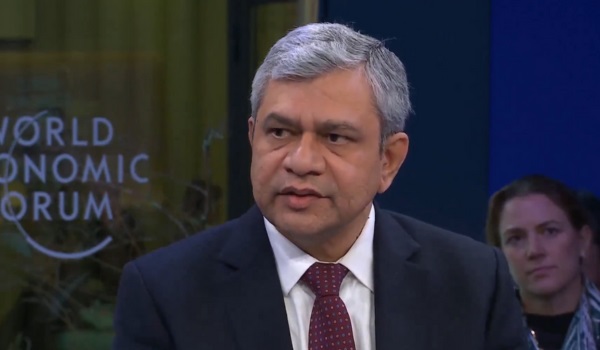
India’s Minister for Electronics and IT Minister Ashwini Vaishnaw Thursday said that India is seen as a trusted value chain partner and as a country that is focused on inclusive growth. In an interview with a private media channel on the sidelines of the World Economic Forum in Davos, Switzerland, Mr Vaishnaw informed that India is working on all five layers of Artificial Intelligence, including AI architecture, application, model, chip, infra and energy.
Speaking during an ongoing global summit, Vaishnaw said India is building AI capabilities across the entire value chain. He explained that the framework begins with the application layer, which focuses on real-world use cases, followed by the model layer that develops AI systems. The third layer is semiconductors or chips, the fourth is digital infrastructure such as data centres, and the fifth is energy.
Vaishnaw described energy as a decisive factor in what he called the fifth industrial revolution, noting that AI growth will increasingly depend on reliable and affordable power. He said India’s coordinated work—from energy planning to application development—has drawn appreciation from the global AI ecosystem.
The Minister also detailed India’s broader strategy to strengthen its position in the global AI landscape, with an emphasis on public-private collaboration. Addressing a panel at the World Economic Forum on the “Role of AI in Economic Growth and Global Influence,” he said India has set up a shared compute facility through a public-private partnership, providing access to around 38,000 GPUs.
According to Vaishnaw, this common compute platform is available to students, researchers and startups at nearly one-third of prevailing global costs, contrasting with systems in many countries where access to GPUs is largely controlled by big technology firms.
On regulation, the Minister argued for a “techno-legal” approach instead of relying only on standalone laws. He said the complexity of emerging technologies demands technical solutions to manage risks such as bias and deepfakes, including detection tools robust enough to meet judicial standards. India, he added, is working on technologies to reduce bias, improve deepfake detection and ensure proper “unlearning” before AI models are deployed.
Vaishnaw also pointed to a shift in the economics of the fifth industrial revolution, saying future returns will depend on scalable and cost-effective innovation rather than brute-force computing. He noted that a large share of AI development can be achieved using mid-sized models in the 20–50 billion parameter range, challenging the view that progress always requires the most expensive hardware.