
Last Updated on July 11, 2026 12:14 pm by BIZNAMA NEWS
AMN / NEWS DESK
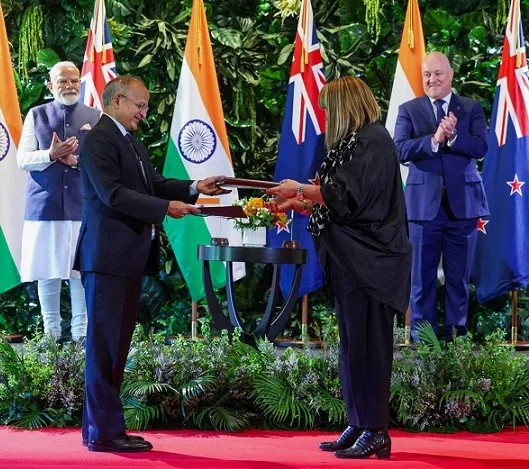
India and New Zealand today elevated their ties to a strategic partnership and set a five-year target to double their annual bilateral trade in goods and services to 35,000 crore rupees by 2030, following talks between Prime Minister Narendra Modi and his New Zealand counterpart Christopher Luxon in Auckland.
The meeting yielded several concrete outcomes. Key among them were a roadmap to expand ties in the next four years, a framework for enhancing Indo-Pacific maritime cooperation, and a reciprocal logistics support pact between the Indian Navy and the New Zealand Defence Force.
The two sides signed 10 agreements and memoranda of understanding (MoUs) while announcing several new initiatives designed to strengthen bilateral engagement under the India-New Zealand Strategic Partnership and Roadmap to 2030.
A major focus of the outcomes was enhancing defence and maritime cooperation. India and New Zealand signed a Memorandum of Arrangement on Maritime Cooperation to strengthen dialogue, information sharing, coordination and joint activities in the Indo-Pacific. They also concluded agreements on hydrography and nautical cartography, enabling joint production of navigational charts, hydrographic data sharing and capacity building, besides a Mutual Logistics Support Arrangement to facilitate reciprocal logistics support between the Indian Navy and the New Zealand Defence Force.
The two countries also agreed to establish a Joint Working Group on Counter-Terrorism to enhance cooperation, intelligence sharing and coordination in tackling terrorism.
In disaster management, the National Disaster Management Authority (NDMA) of India and New Zealand’s National Emergency Management Agency (NEMA) signed a Memorandum of Cooperation focusing on earthquake resilience, tsunami preparedness, coastal hazard mitigation, policy dialogue and capacity building.
The two sides also strengthened cooperation in agriculture through a Memorandum of Cooperation on Animal Husbandry and Dairying, aimed at promoting technical collaboration, knowledge exchange and sharing of best practices.
To boost tourism and people-to-people exchanges, India and New Zealand signed a tourism cooperation agreement to encourage greater tourist flows and strengthen economic and cultural ties.
Sports cooperation also received a boost with the adoption of the India-New Zealand Joint Action Plan on Sport, providing a framework for collaboration in high-performance sports, sports science, sports medicine and athlete development.
The two countries also signed agreements on cultural cooperation and maritime heritage, including collaboration between the National Maritime Heritage Complex (NMHC), Lothal, and the New Zealand Maritime Museum to support the development of the heritage complex in Gujarat.
Among the key announcements, India and New Zealand officially elevated their bilateral relationship to a Strategic Partnership and adopted the Roadmap to 2030, which will guide cooperation across trade, defence, maritime security, tourism, sports, culture, agri-tech, people-to-people exchanges and multilateral engagement over the next four years.
The two countries also set a target of doubling bilateral trade to NZ$7 billion (approximately ₹35,000 crore) by 2030, supported by the recently concluded India-New Zealand Free Trade Agreement.
To strengthen Indo-Pacific cooperation, the two sides agreed to establish a Maritime Security Dialogue, while New Zealand announced that Maritime Security would become its priority pillar under the Indo-Pacific Oceans Initiative (IPOI), with a focus on combating Illegal, Unreported and Unregulated (IUU) fishing.
In the clean energy sector, New Zealand announced its decision to join the Global Biofuels Alliance, reinforcing international collaboration on sustainable biofuels and energy transition.
The two countries also launched a Kiwifruit Action Plan under the Agricultural Productivity Partnership and announced the establishment of two Centres of Excellence for Kiwifruit in Nagaland and Uttarakhand to promote agricultural innovation, skills development and productivity.
Scientific and academic cooperation was further expanded through a collaboration between the National Centre for Polar and Ocean Research (NCPOR), Goa, and the University of Canterbury for Antarctic research, alongside an agreement between NIFTEM-Kundli and Massey University to promote research, student mobility and academic exchanges.