
A R DAS / NEW DELHI
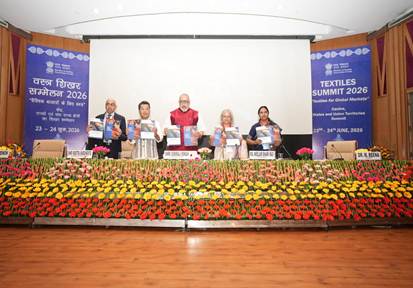
The Ministry of Textiles has inaugurated a pivotal two-day national summit in New Delhi, tailored to transform India into a global textile export powerhouse. Anchored by the Cabinet Secretariat’s push for centre-state collaboration and cooperative federalism, the event sets an ambitious roadmap to scale textile and apparel exports from USD 37 billion to USD 100 billion by 2030.
The summit operationalizes Prime Minister Narendra Modi’s “Farm to Fibre, Fibre to Factory, Factory to Fashion, and Fashion to Foreign” vision through several critical, data-driven milestones:
- Massive Consultative Framework: Culminating one of the ministry’s largest-ever outreach efforts—spanning all 36 States/UTs, 200 district discussions, and 5,000+ stakeholders—the summit successfully yielded 36 State Export Action Plans (SEAPs) and 200 District Export Action Plans (DEAPs).
- District-Led & Cluster Growth: Union Textiles Minister Giriraj Singh emphasized a decentralized, district-led export strategy, urging a pivot toward technical textiles, sustainability, and targeted development in major hubs like Ludhiana, Tiruppur, Surat, and Bhadohi.
- Shifting Global Demands: Industry leaders highlighted a strategic necessity to shift production focus from traditional cotton-based goods to man-made fibre (MMF) textiles and premium segments like GI-tagged products and Pashmina.
- Strengthening the Ecosystem: Policymakers and exporters reviewed critical enablers including access to credit, infrastructure, labor compliance, and the development of PM-MITRA Parks to eliminate supply-chain cost disadvantages.
The actionable insights and regional priorities mapped during the summit will be consolidated into the National Textile Export Roadmap 2030, serving as the definitive strategic blueprint to position India as a preferred global sourcing destination over the next five years.