
Last Updated on June 4, 2026 10:26 pm by BIZNAMA NEWS
By S. N. Verma
Despite India possessing some of the world’s most robust environmental laws, the country’s major river systems remain choked by a familiar trifecta of weak enforcement, fractured bureaucratic coordination, and lagging infrastructure. In recent years, an insatiable demand for water has severely degraded the health of major lifelines like the Ganga—a crisis that climate change is actively accelerating.
In response to this ecological emergency, the Government of India launched the Namami Gange Programme in the 2014–15 fiscal year. Conceived as a holistic, integrated conservation mission, the program was designed to clean and revitalize the Ganga and its vast network of tributaries. Though its initial five-year tenure expired in March 2021, the government has repeatedly extended the initiative, shifting toward a multi-pronged strategy that spans massive wastewater treatment plants, riverfront management, rural sanitation, biodiversity conservation, and public awareness.
According to data recently presented to Parliament by the Union Ministry of Jal Shakti, the sheer financial scale of the mission is staggering. The government has sanctioned 524 projects under Namami Gange at an estimated cost of ₹43,030 crore, with 355 of those projects fully completed. Parallel to this, the National River Conservation Plan (NRCP) has cast a wider net, targeting 58 rivers across 100 cities in 17 states, establishing an infrastructure capable of treating 3,019 million liters of sewage per day.
The stakes could not be higher. The Ganga basin is the literal baseline of Indian civilization, spreading across 11 states, covering 27 percent of the nation’s landmass, and nourishing nearly half its population. The crisis is mirrored in the south as well, where active pollution-mitigation efforts are underway across crucial river systems including the Musi, Godavari, Krishna, Narmada, Cauvery, Mahanadi, and Periyar basins.
Yet, despite this massive infrastructure push, on-ground results paint a complicated, uneven picture. Regular manual monitoring conducted by the Central Pollution Control Board (CPCB) across 112 locations in Uttarakhand, Uttar Pradesh, Bihar, Jharkhand, and West Bengal reveals that while the river is healing in parts, critical choke points remain dangerously toxic.
The good news is that the main stream of the Ganga has shown marked improvements compared to a decade ago. CPCB reports show that dissolved oxygen and pH levels across all tested locations now comfortably meet the strict criteria required for outdoor bathing. Furthermore, biological water quality monitoring across 50 locations on the Ganga and 26 on the Yamuna rates the organic health of the water as “good to moderate.”
The compliance breaks down, however, when measuring Biochemical Oxygen Demand (BOD)—a key indicator of organic pollution. While the entire flow of the Ganga across Uttarakhand, Bihar, Jharkhand, and West Bengal satisfies BOD standards, severe violations plague the industrial heartland of Uttar Pradesh. The river fails environmental standards across heavily populated stretches extending from Farrukhabad to Kanpur’s Old Rajapur, and from Dalmau in Rae Bareli down to Mirzapur and Tarighat in Ghazipur.
This localized failure underscores a deeper systemic reality: river cleaning is a continuous process that cannot be managed entirely from New Delhi. While the central government provides the budgetary backbone, the primary operational burden rests on state governments, urban local bodies, and industries, which are legally required to treat domestic and industrial waste before it meets the water.
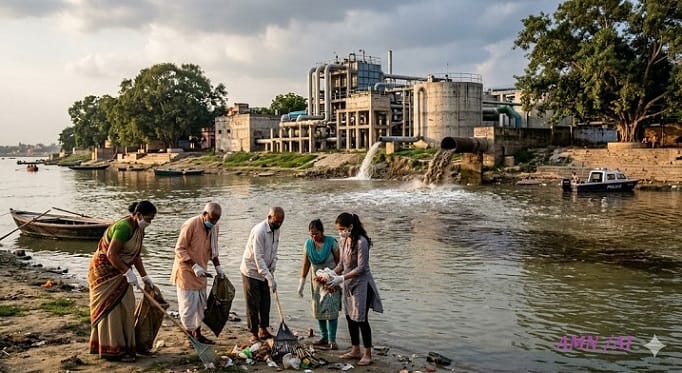
To bridge this civic gap, Namami Gange has tried to pivot toward public mobilization. Massive public relations campaigns—ranging from Swachhta Pakhwada and the Ganga Utsav to rafting expeditions, tree plantations, and ghat-side yoga—aim to foster community ownership. Innovative frameworks like Ghat mein Haat have even attempted to tie river conservation directly to local economic livelihoods.
India’s judiciary has also historically stepped in where executives have lagged. In the landmark M.C. Mehta v. Union of India case of 1987, the Supreme Court famously ruled that the right to a pollution-free environment is an intrinsic part of the fundamental Right to Life under Article 21 of the Constitution. Under this ongoing litigation, the court prohibited industries from discharging untreated waste into the Ganga. However, in a major procedural shift, the Supreme Court closed its self-directed monitoring proceedings, transferring primary surveillance to the National Green Tribunal (NGT), noting that specialized environmental courts are better equipped for continuous, technical oversight.
Yet, why does the river remain polluted? The answer lies in persistent administrative bottlenecks. Effective enforcement against polluting industries is severely hampered by acute staff shortages and weak surveillance at state pollution control boards. Along the Yamuna, for instance, factories regularly bypass laws to dump untreated toxic waste because round-the-clock regulatory monitoring is virtually nonexistent. Nationwide, over 60 percent of urban sewage continues to flow directly into water bodies completely untreated, routinely outpacing the construction of new treatment facilities.
Compounding this is the classic problem of bureaucratic red tape. Multi-agency governance creates operational overlaps; state pollution control boards frequently fail to coordinate with municipal bodies, paralyzing enforcement actions against illegal waste dumping. Most damningly, bureaucratized delays in approving project reports have bottlenecked the flow of money. Strikingly, only 69 percent of the total funds allocated for the Namami Gange program were actually utilized up to the fiscal year, leaving billions of rupees sitting on the sidelines while India’s holiest river continues its fight for survival.