
Last Updated on June 11, 2026 1:30 pm by BIZNAMA NEWS
By TN Ashok
History recorded the moment quietly, as historic moments in India often are — buried beneath the noise of a raucous democracy, acknowledged in Cabinet resolutions and social media posts before being absorbed into the relentless churn of electoral arithmetic.
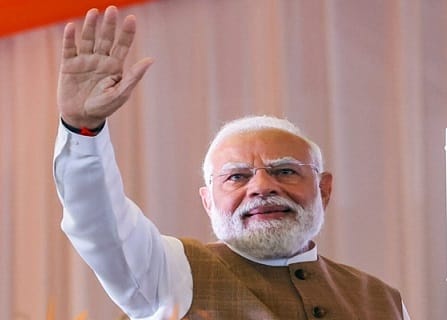
On June 10, 2026, Narendra Modi crossed 4,399 consecutive days in office, becoming India’s longest continuously serving Prime Minister, surpassing the record set by Jawaharlal Nehru after the country’s first general election.
In just twelve years, Modi had done what Nehru accomplished across sixteen — won three consecutive mandates, dominated a civilisational democracy of 1.4 billion people, and so thoroughly redefined the terms of Indian politics that the opposition is no longer quite sure what it is opposing, or how.
The symbolism was not lost on anyone. Nehru built modern India’s institutional architecture. Modi has systematically rewritten who lives inside it, and on whose terms. To surpass Nehru is not merely a record. It is a statement of succession — not of lineage, but of dominance.
The question that now presses urgently upon the republic is whether the India of 2029 will be contested at all, or whether the opposition, hemorrhaging allies and credibility simultaneously, will arrive at the next general election as a parliamentary afterthought.
The June 8 INDIA bloc conclave in New Delhi was meant to project unity. It projected the opposite. The DMK announced it would boycott the meeting, a decision stemming from a bitter fallout following the Tamil Nadu assembly elections, where Congress abandoned its two-decade alliance with the party to join a coalition government under actor-turned-politician C. Joseph Vijay’s Tamilaga Vettri Kazhagam.
From DMK’s perspective, this was not tactical flexibility. It was betrayal. On the day of the conclave itself, DMK spokesperson T.K.S. Elangovan confirmed the party had formally exited the opposition grouping, attributing the decision entirely to Congress’s conduct. The Aam Aadmi Party, burdened by years of bruising rivalry with Congress in Delhi and Punjab, also stayed away.
The meeting that did convene featured Sonia Gandhi, Rahul Gandhi, Mallikarjun Kharge, Mamata Banerjee, Akhilesh Yadav and Omar Abdullah — a respectable assembly on paper, a diminished one in reality. An alliance that once aspired to represent the full breadth of India’s anti-BJP politics now resembles a parliament of reduced ambitions.
The DMK’s exit alone strips the INDIA bloc of its most credible southern anchor — 22 Lok Sabha seats from Tamil Nadu that, in 2024, were instrumental in denying Modi an outright majority.
And then there is West Bengal, where the crisis is not merely electoral but existential. The Trinamool Congress, the party Mamata Banerjee built from the ruins of Congress in Bengal and nurtured for three decades on a combination of personality cult and welfare populism, is haemorrhaging at a pace that has begun to resemble structural collapse rather than ordinary factionalism.
After its devastating setback in the 2026 assembly elections — a contest the BJP fought with surgical precision in a state they have been eyeing since Amit Shah’s booth-level penetration campaigns began in 2018 — defectors are not merely leaving the TMC. They are joining the BJP.
Every defector who crosses the aisle carries with them voter data, local networks and the institutional memory of how the TMC actually won elections in that constituency.
The meetings this week in Delhi between Mamata, Sonia Gandhi, Rahul Gandhi and Abhishek Banerjee are being publicly described as routine consultations. They are nothing of the sort. They are a renegotiation of survival.
A full merger remains implausible — Mamata has not spent thirty years building a personal political brand to dissolve it into Congress’s national identity, however diminished that identity currently is. What is being discussed, more plausibly, is a strategic co-habitation: shared platforms, coordinated candidates, a working arrangement that stops short of merger but signals enough consolidation to prevent the BJP from picking off both parties separately. Whether even that is achievable before the 2027 state elections in Uttar Pradesh and Punjab will determine everything that follows.
Those two elections are the real proving ground. Uttar Pradesh is the graveyard of opposition ambition. No national government has been formed without either winning UP or neutralising its verdict elsewhere.
The Samajwadi Party under Akhilesh Yadav retains a formidable caste coalition — the PDA (Pichhda, Dalit, Alpsankhyak) formula that delivered a near-upset in 2024 — but the BJP’s welfare delivery machine, Yogi Adityanath’s muscular administrative persona, and the relentless amplification of Hindu consolidation narratives remain powerful countervailing forces.
If the INDIA bloc, in whatever reconstituted form it takes, manages to meaningfully disturb BJP in UP — reducing its seat tally below its 2017 peak, winning enough urban constituencies to signal that economic discontent has breached the BJP’s cultural firewall — it changes the momentum calculus entirely heading into 2029. If the BJP sweeps UP and adds Punjab to its column, the road to any viable opposition coalition becomes almost cartographically impossible.
Punjab is the softer target, but not a guaranteed hold. AAP’s governance there has been periodically turbulent, and Congress has not entirely surrendered its legacy base in the state. A BJP consolidation in Punjab — particularly if it can leverage Sikh community anxieties around federalism and farm policy — would represent a dramatic extension of the party’s geography northward.
Two: BJP wins in 2027 would effectively hand Modi and the party an eighteen-month victory lap into the 2029 campaign, with every instrument of the state narrative turned toward momentum.
Yet there is a new variable in this calculation that no electoral model has fully priced in: the Iran war and its inflationary aftershock.
The conflict that erupted in West Asia has sent oil prices through trajectories that Indian household budgets absorb with unmistakable pain. India imports approximately 85 percent of its crude requirements. Every sustained spike in Brent translates, with only modest lag, into higher fuel costs, elevated transport prices, dearer food, and the particular economic anxiety of the urban lower-middle class — precisely the constituency the BJP worked so hard to bring under its welfare tent between 2014 and 2024.
Conversations in tea stalls from Kanpur to Coimbatore, as one political operative recently noted with some discomfort, have begun to sound less like identity affirmation and more like kitchen-table grievance.
The BJP has demonstrated, repeatedly and impressively, an ability to pivot elections away from economic discomfort toward security, nationalism and welfare framing. Modi’s personal approval ratings have shown extraordinary resilience through previous economic stress cycles.
But inflation is a patient adversary. It works cumulatively, not dramatically. It erodes trust in the margins — among beneficiaries who received gas cylinders under Ujjwala but now cannot refill them, among first-time salaried workers whose income has not kept pace with grocery bills, among farmers watching input costs climb while MSP debates remain unresolved. These are not revolutionary grievances. They are the quiet, grinding dissatisfactions that reshape electoral outcomes without announcing themselves in opinion polls until the last moment.
For the opposition, the tragedy is one of timing. Precisely when the BJP faces its most authentic economic vulnerability in a decade, the INDIA bloc is in the process of eating itself. The DMK is gone. AAP is absent. The TMC is cracking. Congress, the only party with a national spine capable of holding an anti-BJP coalition together, remains institutionally fragile outside Karnataka and Himachal Pradesh.
Twelve years of Modi have produced, paradoxically, both a more developed India and a more politically impoverished one — impoverished in the sense that the muscular, competitive, ideologically diverse opposition that a democracy of India’s scale deserves has been unable to cohere around anything more durable than shared resentment of a single man. Resentment, as Indian political history has shown repeatedly, is sufficient to win one election. It is never sufficient to build a governing alternative.
The road to 2029, for the opposition, does not run through Delhi drawing rooms. It runs through wheat fields in Uttar Pradesh, through the deindustrialised margins of Bengal, through the auto-rickshaw driver in Ludhiana calculating what the Iran war has done to his daily fuel bill.
If the INDIA bloc — or whatever emerges from its current disaggregation — cannot translate those economic anxieties into a coherent political argument before the 2027 elections deliver their verdict, then Modi’s thirteenth year in office may well be the first of a final, uncontested chapter.
And Nehru’s record, having been broken, will simply continue to fall.
TN Ashok is a New Delhi-based international affairs journalist and diplomatic correspondent.