
Last Updated on July 5, 2026 12:57 am by BIZNAMA NEWS
By S. N. Verma
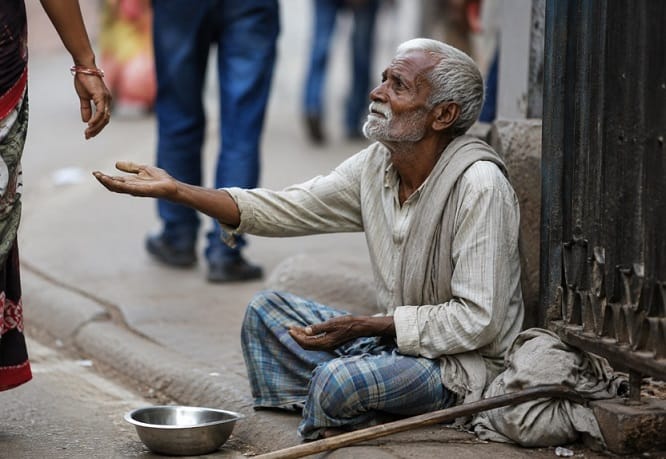
Despite India’s meteoring trajectory as a global economic powerhouse, a stark, historic paradox continues to line its urban centers: the persistent crisis of begging. Official estimations indicate that there are approximately 500,000 beggars across the nation. This reality persists even though the act of begging remains a penalized offense across a majority of Indian states.
However, beneath the surface of urban poverty lies a deeply complex, multi-layered ecosystem. The crisis oscillates between genuine socio-economic marginalization and highly organized criminal exploitation, rendering a completely “Beggar-Free India” one of the most challenging policy goals for the modern state.
The Landscape of Urban Distress: Regional and Demographic Realities
The demographic spread of begging in India reflects systemic regional disparities. According to data from the national census, West Bengal and Uttar Pradesh house the highest concentrations of individuals engaged in begging. The internal dynamics of these states, however, differ significantly: Uttar Pradesh exhibits a critical prevalence of child begging, whereas West Bengal records a disproportionately high number of disabled beggars. Significant populations are also documented in Andhra Pradesh, Bihar, Madhya Pradesh, Rajasthan, Maharashtra, Assam, and Odisha.
[Urban Migration / Job Deficit] ──> [Socio-Economic Compulsion] ──> Genuine Begging
[Human Trafficking Networks]   ──> [Coercion & Disfigurement]   ──> Organized Syndicate
A deeper statistical breakdown by the Ministry of Social Justice highlights distinct intersectional vulnerabilities. Across the total national begging population, the gender split averages 53.13% male and 46.87% female. Interestingly, religious and gender cross-data reveals unique trends: while the overall data is dominated by male beggars, within the Muslim begging demographic—which constitutes roughly 25% of the total—the ratio flips dramatically, with females comprising 56.38% and males 43.61%. In comparison, Hindus represent 72.2% of the begging populace (relative to a 79.8% share in the national population), while Christians (0.88%), Sikhs (0.45%), Buddhists (0.25%), and Jains (0.06%) account for minor percentages.
The Organized Syndicates: Turning Human Misery into a Multi-Crore Business
Sociologists classify India’s begging population into two distinct operational groups:
- The Compelled: Individuals driven to the streets by acute poverty, displacement, sudden physical disability, or chronic mental illness.
- The Professionals: Individuals subsumed into systemic networks where begging is treated as a calculated, high-yield trade.
In major metropolitan hubs, begging operates as a sophisticated, multi-crore illicit economy controlled by deeply entrenched human trafficking syndicates. These cartels partition urban territories into profitable zones—such as high-traffic intersections, transit hubs, and religious spots. To secure the “right” to beg in these prime locations, individual beggars must surrender a massive chunk of their daily earnings to a localized handler or gang leader.
The tactics deployed by these cartels to evoke public empathy are brutally calculated. Syndicates frequently lease infants from impoverished families for daily fees, drugging the children so they appear chronically ill or unconscious in the arms of women on the streets.
Even more harrowing is the targeted weaponization of child trafficking. The National Human Rights Commission (NHRC) reports that up to 40,000 children are kidnapped across India annually. A massive portion of these missing children are systematically funneled into begging mafias, where they are subjected to deliberate physical disfigurement, starvation, and psychological trauma to optimize their “earning capacity.” Law enforcement frequently struggles to break these rings, often misidentifying trafficked minors as family members of the adult handlers due to a lack of rapid, on-field verification protocols.
From Criminalization to Rehabilitation: Shifting Institutional Models
For decades, India’s legal approach toward begging was primarily punitive. In the absence of a comprehensive central law, states relied on regional statutes—such as the Bombay Prevention of Begging Act, 1959—which effectively criminalize destitution, treating the visible poor as law-and-order infractions rather than subjects of state welfare.
A landmark shift occurred in 2021 when the Supreme Court of India dismissed a Public Interest Litigation (PIL) seeking a blanket ban on beggars from public spaces. The apex court ruled that begging is fundamentally a socio-economic symptom born out of systemic state and societal failure, noting that criminalizing a person’s survival mechanism in the absence of institutional alternatives is a violation of basic rights.
Old Punitive Approach (e.g., Bombay Act) ──> Detention & Criminalization
     ▼
New Welfare Paradigm (SMILE Scheme)      ──> Identification ──> Rehabilitation ──> Re-skilling
In response to this modern paradigm, the Ministry of Social Justice and Empowerment launched the SMILE (Support for Marginalised Individuals for Livelihood and Enterprise) initiative. Under its sub-scheme, the Massive Rehabilitation of Persons Engaged in Begging, the government has shifted its focus from incarceration to holistic reintegration.
The institutional framework relies heavily on data-driven interventions:
- The SMILE-Bagri App: Launched at the national Chintan Camp in Chandigarh, this specialized mobile application allows field workers to identify, log, and continuously track vulnerable individuals in real time.
- Targeted Urban Shifts: The central government has rolled out pilot programs to liberalize 30 major tourist and religious destinations—including high-density spiritual centers like Ayodhya and Ujjain. The current policy target aims to sustainably transition and resettle individuals away from begging in these zones.
- Measurable Progress: Parliamentary data indicates that out of 31,055 individuals officially identified under the scheme, thousands—including nearly 2,500 children—have been successfully moved into formal state rehabilitation pathways, featuring medical aid, basic education, and vocational re-skilling.
The Road Ahead: Breaking the Cycle of Dependence
The success of municipal zones like Indore—recognized as India’s first “beggar-free” city—alongside heritage areas like Sanchi, proves that absolute rehabilitation is possible when local administrations seamlessly combine strict anti-trafficking law enforcement with robust social safety nets.
However, scaling these isolated successes into a nationwide reality requires addressing the root systemic drivers: rural-to-urban migration failures, systemic job deficits, and gaps in mental healthcare infrastructure. Until state policies completely eradicate the multi-crore criminal networks that profit off human exploitation while simultaneously creating viable, long-term employment options for the genuinely destitute, the eradication of begging will remain a work in progress.
(The writer is an independent journalist and columnist)