
Last Updated on April 10, 2026 4:09 pm by BIZNAMA NEWS
HEALTH DESK
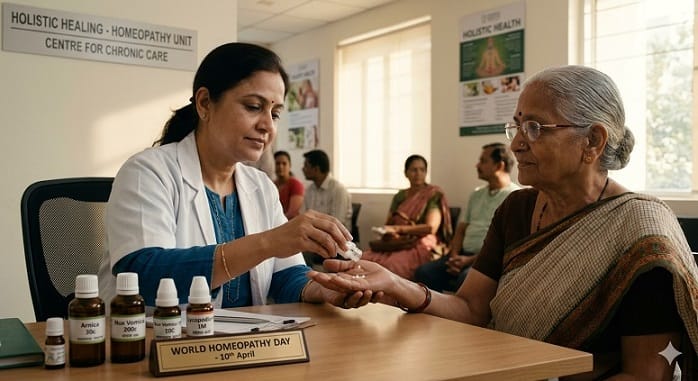
April 10th is observed as World Homeopathy Day. The date is not arbitrary; it marks the birth anniversary of Dr. Christian Friedrich Samuel Hahnemann, the German physician who founded homeopathy in the late 18th century. Based on the principle of Similia Similibus Curentur—or “like cures like”—homeopathy posits that a substance that causes symptoms in a healthy person can, in highly diluted forms, treat similar symptoms in a sick person.
While the system has faced its share of skepticism in the West, it has found a unique and enduring home in the East. Today, homeopathy stands as the second most practiced system of medicine globally, according to the World Health Organization, with India leading the charge as a global hub for its practice, education, and manufacture.
The Indian Affinity: A Preference for the Gentle Path
In India, homeopathy is more than just an “alternative” therapy; it is a mainstream choice integrated into the national healthcare framework under the Ministry of AYUSH. The preference for these small, sweet globules isn’t merely a result of tradition, but a conscious choice made by millions of patients, particularly those battling chronic conditions.
Why Chronic Patients Choose Homeopathy
For those suffering from long-term ailments like arthritis, skin disorders (psoriasis and eczema), respiratory issues (asthma and sinusitis), and lifestyle diseases (PCOS or thyroid imbalances), conventional medicine often offers management rather than a “cure,” sometimes accompanied by heavy side effects.
- Holistic Individualization: Unlike the “one size fits all” approach, a homeopathic consultation is exhaustive. It looks at the patient’s temperament, sleep patterns, emotional state, and even food cravings. For a chronic sufferer, this personalized attention provides a sense of being “heard” that is often missing in crowded OPDs.
- Safety and Side Effects: Chronic conditions require long-term medication. Patients often turn to homeopathy to avoid the gastric issues, kidney strain, or hormonal disruptions sometimes associated with long-term use of steroids or painkillers.
- Cost-Effectiveness: In a country where out-of-pocket healthcare spending can be a burden, homeopathy remains remarkably affordable. The low cost of medicines makes it accessible to the rural heartlands and the urban middle class alike.
Navigating the Storm: Challenges in the Modern Era
Despite its popularity, the path forward for homeopathy is not without significant hurdles. For it to transition from a “popular preference” to a universally accepted medical science, several systemic challenges must be addressed.
The Research Gap
The most persistent criticism leveled against homeopathy is the lack of “high-quality” clinical evidence that meets the standards of modern Evidence-Based Medicine (EBM). While thousands of successful case studies exist, large-scale, double-blind, placebo-controlled trials are fewer.
The “ultra-dilution” of homeopathic remedies—where the original substance is often undetectable—remains a sticking point for physicists and pharmacologists. Bridging this gap requires innovative research into nanomedicine and the physical properties of water memory, yet this kind of high-level interdisciplinary research is still in its infancy.
Funding and Infrastructure
While the Indian government has increased the budget for AYUSH, the lion’s share of medical funding still flows toward conventional medicine. Research in homeopathy requires sophisticated laboratories and long-term funding cycles to track chronic patients over years. Without significant private and public investment, the development of new remedies and the standardization of existing ones remain slow.
Dissemination and Misinformation
There is a massive “communication gap” in how homeopathy is presented to the world. On one side, enthusiasts claim it can cure everything (which is untrue and dangerous), and on the other, critics dismiss it as a “placebo effect.”
The lack of effective dissemination of successful scientific data means that many breakthroughs in homeopathic research remain confined to niche journals, never reaching the wider medical community or the international press. This affects “wider acceptance” among the global scientific elite and policy makers.
The Way Forward: An Integrated Future
As we celebrate World Homeopathy Day, the focus is shifting toward Integrative Medicine. The goal is no longer to choose one system over the other, but to utilize the strengths of both.
India has already taken steps toward this by co-locating AYUSH facilities in Primary Health Centers. By fostering rigorous scientific inquiry and addressing the funding bottlenecks, homeopathy can move beyond being a “trusted tradition” to becoming a “validated science.”
For the millions of patients who find relief in those tiny white pills when all else fails, the debate over “how” it works is secondary to the fact that it does work. On this day, we honor that relief and the 200-year-old legacy of a system that continues to heal with a gentle touch.