
ADITYA RAJ DAS
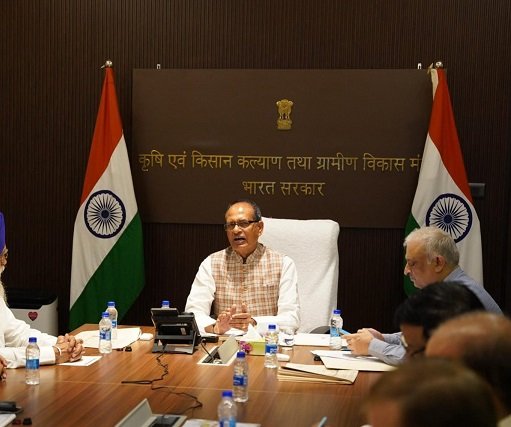
Union Minister for Rural Development and Agriculture & Farmers’ Welfare Shivraj Singh Chouhan on Sunday described the Union Budget 2026–27 as “historic and unprecedented”, saying it lays a strong foundation for building a developed and self-reliant India under the leadership of Prime Minister Narendra Modi.
Addressing the media, Chouhan noted that this was the 12th Union Budget presented under Prime Minister Narendra Modi’s leadership and the ninth consecutive Budget presented by Nirmala Sitharaman, making her the first woman Finance Minister to achieve the milestone.
Calling it a “dynamic Budget for a Developed India (Viksit Bharat)”, the Union Minister said the Budget is aimed at social prosperity and the fulfilment of national aspirations. He said it focuses on transformative change in the lives of farmers, youth, women and the poor, whom he described as the four pillars of the nation.
Chouhan said the Budget has been framed with villages, the poor, farmers, youth and women at its core. He noted that poverty has been steadily declining due to welfare schemes implemented under the Modi government and said the current Budget would further strengthen efforts to make the poor self-reliant.
Highlighting initiatives for rural women, the Union Minister said the Budget builds on the success of the ‘Lakhpati Didi’ programme through the introduction of ‘SHE-Mart’. Under the initiative, community-owned retail outlets will be established in every district to provide market access for products made by women Self-Help Groups and rural entrepreneurs. He said the move would help women engaged in agriculture, animal husbandry and allied activities transition from subsistence livelihoods to entrepreneurship.
Chouhan said the Budget for the Ministry of Rural Development has been increased by 21 per cent this year. He added that when viewed together, the combined allocation for the Rural Development and Agriculture ministries has crossed ₹4.35 lakh crore, underscoring the government’s commitment to villages and farmers.
He said a provision of over ₹1.51 lakh crore, including states’ contributions, has been made under the ‘Viksit Bharat Gram G’ scheme. On MGNREGA, the Union Minister said the Centre’s share has been increased to over ₹95,692 crore, and with states’ contributions, the total allocation will exceed ₹1.51 lakh crore, calling it a historic allocation.
The Union Minister said that under the recommendations of the 16th Finance Commission, more than ₹55,900 crore will be transferred directly to panchayats. He noted that while panchayats had received around ₹2.36 lakh crore directly over an earlier five-year period, this has now risen to about ₹4.35 lakh crore, nearly doubling direct assistance.
He expressed confidence that the combined allocations under the ‘Viksit Bharat Gram G’ scheme and Finance Commission transfers would play a crucial role in creating self-reliant, employment-oriented and poverty-free villages.
Speaking on the agriculture sector, Chouhan said the agriculture budget has been increased to ₹1,32,561 crore in 2026-27. He added that ₹9,967 crore has been allocated for agricultural education and research, particularly for the Indian Council of Agricultural Research (ICAR), to strengthen innovation and productivity.
To reduce input costs for farmers, the Budget has provided a fertiliser subsidy of over ₹1.70 lakh crore to ensure the availability of affordable fertilisers.
The Union Minister said the National Fibre Scheme will focus on fibres such as silk, wool and jute, providing direct benefits to farmers associated with these sectors. He also said that provisions for the certification and export of medicinal plants under the Ministry of AYUSH would help increase incomes of farmers engaged in medicinal plant cultivation.
Chouhan added that the Budget makes clear provisions for high-value crops such as coconut, cocoa, cashew and sandalwood, including the rejuvenation of old coconut plantations and the establishment of new orchards. He said steps have also been taken to boost fruit and vegetable production and improve their movement to markets to ensure better prices for farmers and improved access for consumers.