
ANDALIB AKHTER
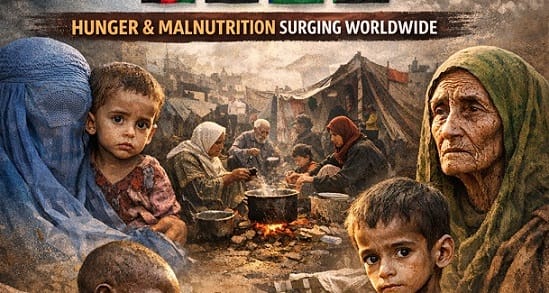
The latest edition of the Global Report on Food Crises (GRFC) 2026 delivers a stark and unsettling message: hunger is no longer a passing emergency—it is becoming a permanent feature of the global landscape. According to the Global Network Against Food Crises, acute food insecurity has not only persisted but doubled over the past decade, exposing deep structural failures in how the world addresses hunger.
At the heart of this crisis lies a troubling concentration. Just ten countries—including Afghanistan, Sudan, Yemen, and Nigeria—account for nearly two-thirds of people facing severe hunger. These are not isolated cases but long-running crises, where conflict, economic fragility, and climate shocks overlap to create what experts now describe as “protracted food emergencies.” In many of these regions, hunger is no longer seasonal or cyclical—it is chronic.
Perhaps the most alarming development highlighted in the report is the confirmation of famine in two separate regions in 2025—Gaza and parts of Sudan. This marks the first time such a situation has been recorded simultaneously since the report’s inception. The designation, based on the Integrated Food Security Phase Classification, represents the most extreme form of food deprivation, where starvation, death, and irreversible health damage are widespread. That famine has returned in multiple locations is not just a humanitarian failure; it is a global moral indictment.
The numbers themselves are staggering. An estimated 266 million people across 47 countries experienced high levels of acute food insecurity in 2025—nearly a quarter of the population assessed. Even more concerning is the surge in those facing catastrophic hunger, a figure now nine times higher than in 2016. This sharp rise underscores a dangerous trend: while global attention may shift from one crisis to another, hunger continues to deepen in the shadows.
Children remain the most vulnerable victims. In 2025 alone, 35.5 million children were acutely malnourished, with nearly 10 million suffering from severe forms that significantly increase the risk of death. Malnutrition is not merely a consequence of food shortages; it is a symptom of broken systems—poor healthcare, unsafe water, and inadequate social protection. In places like Gaza, Myanmar, and South Sudan, these overlapping crises have pushed communities to the edge of survival.
Conflict remains the single largest driver of hunger. As António Guterres noted, war not only destroys livelihoods but also blocks humanitarian access, turning food into a weapon. Displacement further compounds the crisis. More than 85 million people were forcibly displaced in food-insecure regions last year, often finding themselves in conditions even more precarious than those they fled.
Yet, even as needs rise, the global response is weakening. Funding for food security and nutrition programs has dropped to levels last seen nearly a decade ago. This decline is particularly alarming because it limits both immediate relief efforts and long-term investments in resilience. Without adequate resources, even the most effective strategies cannot be implemented at scale.
Equally concerning is the growing gap in reliable data. The report warns that the apparent decline in hunger figures in some regions may be misleading, driven not by real improvements but by a lack of data. Several major crisis-affected countries, including Ethiopia and Burkina Faso, were unable to provide updated assessments. In a world increasingly driven by evidence-based policymaking, the absence of data risks rendering millions of people invisible.
Looking ahead to 2026, the outlook remains bleak. Ongoing conflicts, climate variability, and economic uncertainty are expected to sustain or worsen food insecurity in many regions. The ripple effects of geopolitical tensions—particularly in the Middle East—could disrupt global food and energy markets, further straining vulnerable populations.
However, the report is not merely a catalogue of despair; it is also a call to action. It emphasizes that food crises are no longer temporary shocks but predictable outcomes of systemic vulnerabilities. Addressing them requires a fundamental shift—from reactive aid to proactive resilience. Investments in local agriculture, climate adaptation, and rural livelihoods are essential to breaking the cycle of dependency.
Leaders across international organizations echo this urgency. Cindy McCain warned that while the world has the knowledge and tools to end hunger, what is lacking is collective political will. Similarly, Catherine Russell highlighted the moral failure of allowing millions of children to suffer in a world that produces enough food to feed everyone.
The path forward is clear but challenging. It requires not only increased funding but also better coordination between humanitarian, development, and peacebuilding efforts. Ensuring safe access for aid, upholding international humanitarian law, and addressing the root causes of conflict are all critical components of a sustainable solution.
Ultimately, the global hunger crisis is not just about food—it is about inequality, governance, and priorities. In a world of unprecedented wealth and technological advancement, the persistence of mass hunger raises uncomfortable questions. The GRFC 2026 forces us to confront a harsh reality: hunger is not inevitable, but allowing it to continue is a choice.
The question now is whether the international community is willing to act decisively—or whether future reports will continue to document a crisis that the world chose not to end.