

By S. N. Verma
At first glance, highways and honeybees seem to belong to entirely different worlds—one defined by speed and concrete, the other by quiet cycles of nature. Yet a new initiative by the National Highways Authority of India (NHAI) seeks to bring them together in a way that could redefine how India approaches development.
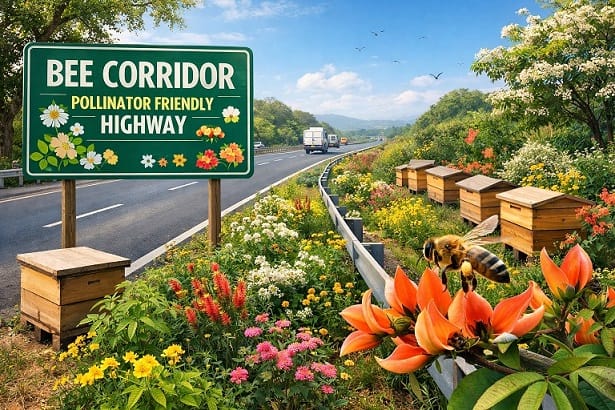
The plan to develop “bee corridors” along national highways is more than a plantation drive; it signals a shift in thinking. Instead of treating roadside greenery as mere decoration, NHAI is attempting to transform it into functional ecological infrastructure. Beginning with stretches in Jharkhand—including Barhi–Ranchi–Jamshedpur, Hazaribagh–Kodarma, Govindpur–Sahibganj, and Deoghar–Basukinath—this initiative aims to plant nectar-rich indigenous species such as neem, karanj, mahua, palash, jamun, and siris. These are not random choices; they are carefully selected to ensure year-round availability of nectar and pollen for bees.
This matters more than it may appear. Pollinators, especially bees, are central to agricultural productivity and ecological balance. It is widely estimated that nearly one-third of global food production depends on pollination. Yet, across India and the world, bee populations are under stress due to habitat loss, pesticide use, and climate change. In this context, the idea of integrating pollinator-friendly habitats into highway design is both timely and necessary.
What makes the concept particularly compelling is its scale and structure. NHAI plans to plant millions of trees, with a significant proportion dedicated to bee-friendly species. These plantations will not be isolated patches but continuous corridors, developed at intervals based on local agro-climatic conditions. The intention is to create a network of green strips that function as safe passages and feeding grounds for pollinators.
This marks a departure from the conventional approach to infrastructure development in India, where ecological considerations often remain secondary. The bee corridor initiative suggests that development and environmental responsibility need not be in conflict. Instead, they can reinforce each other. By improving pollination, such corridors can indirectly boost agricultural yields, support rural livelihoods through honey production, and strengthen local ecosystems.
Equally important is the emphasis on indigenous species. Too often, plantation drives rely on ornamental or fast-growing exotic plants that offer little ecological value. By prioritising native, nectar-rich species, the initiative aligns itself with the principles of ecological restoration rather than cosmetic greening. The inclusion of diverse plant forms—trees, shrubs, herbs, and grasses—further enhances habitat quality, ensuring that flowering cycles are staggered across seasons and that pollinators have continuous access to food.
There is also a broader lesson here about the future of infrastructure. As India expands its road network, the environmental footprint of such projects becomes a critical concern. Initiatives like the bee corridor offer a model for embedding sustainability into the very design of infrastructure, rather than treating it as an afterthought. If implemented effectively, this approach could be replicated across states and even serve as a template for other countries.
However, the success of the project will depend on execution. Plantation drives in India have often struggled with maintenance, survival rates, and long-term monitoring. Ensuring that these corridors remain functional ecosystems—not just rows of planted saplings—will require sustained commitment, scientific oversight, and community participation.
Still, the idea itself deserves attention and encouragement. In an era of climate uncertainty and ecological decline, solutions need not always be grand or complex. Sometimes, they begin with reimagining the spaces we already have.
Transforming highways into lifelines not just for vehicles, but for biodiversity, is one such reimagination. If nurtured carefully, India’s bee corridors could become a quiet yet powerful symbol of how development can move in harmony with nature—one flowering tree at a time.
Writer is an independent journalist and columnist