

Last Updated on April 27, 2026 8:18 pm by BIZNAMA NEWS
ANDALIB AKHTER / NEW DELHI
India today signed a forward-looking FTA with New Zealand, marking a historic milestone in bilateral economic relations. It is a comprehensive framework encompassing market access, agricultural productivity, investment, talent mobility, collaboration in sports, tourism, and people-to-people ties. The FTA is designed to benefit manufacturers, farmers, MSMEs, women entrepreneurs, students, and skilled professionals across both nations.
The Free Trade Agreement between India and New Zealand will advance a new Era of Economic Partnership and Opportunity. New Zealand has committed to facilitating investments of 20 billion dollars into India over the next fifteen years. According to the FTA, a new generation trade deal for Viksit Bharat 2047, encompassing Tariffs, Talent, Investment and Farm Productivity, empowering youth, farmers, women, artisans, and MSMEs, has been agreed upon. The trade includes 100% duty-Free Access across all tariff lines, benefiting diverse sectors.
The FTA promotes India’s AYUSH systems internationally, encourages medical value travel, and positions India as a global wellness hub. The agreement has further given a boost to farms, fisheries and factories through Zero-duty market access on 100 per cent of India’s exports. To ensure protection for farmers, rural economies and the domestic industry, the Government has excluded key sensitive sectors such as dairy, animal products and agricultural products. The FTA will also boost student mobility through post-study work visas and professional pathways in New Zealand, with no numerical caps on Indian students. The India-New Zealand FTA stands as a significant step in India’s journey towards becoming a globally competitive, inclusive and resilient economy under the vision of Viksit Bharat 2047.
India and New Zealand announced negotiations for a Free Trade Agreement (FTA)on 16 March 2025and concluded in a record 9 months, making this the fastest concluded free trade agreement. The signing of FTA enhances market access and tariff preferences for Indian exports to New Zealand, while serving as a gateway to the wider Oceania and Pacific Island markets. The agreement opens opportunities for India to emerge as a key supplier of skilled workforce, alongside prospects for future cooperation in areas such as AYUSH and services such as Yoga Instructors, Indian Chefs, and Music Teachers, and services under sector of interests like IT, Engineering, Healthcare, Education, and Construction.
At USD 49,380, New Zealand is among the higher-income economies in Oceania. In 2024, New Zealand’s imports stood at USD 47 billion, while exports were USD 42 billion. New Zealand invests nearly 8% of its GDP annually overseas, with total overseas investment valued at USD 422.6 billion as of March 2025.
Around 300,000 persons of Indian origin and NRIs live in New Zealand, making up nearly 5% of its population. This diaspora acts as a cultural and economic bridge, supporting stronger bilateral ties and demand for Indian goods and services.
This FTA builds on the socio-economic foundation aimed at creating new opportunities.
- Merchandise Trade: Grew from USD 873 million in 2023–24 to USD 1.3 billion in 2024–25, registering a 49% growth.
- Merchandise Exports to New Zealand: Rose to USD 711 million in 2024–25, showing a positive trend of 32%.
- Services Trade: India’s services exports to New Zealand grew by 13% in 2024, reaching USD 634 million. Major sectors include travel, IT, and business services.
- India and New Zealand merchandise bilateral trade increased from USD 855 Million in 2015-2016 to USD 1298 Million in 2024-2025. The exports increased by 130% whereas imports only increased by 7.21% in 10 years. In 2024-25, the exports from India to New Zealand was higher than imports from New Zealand, maintaining positive trade balance with the country.
Salient Features of the FTA
- The FTA eliminates duty on 100% of Indian Exports
- A USD 20 billion investment commitment over 15 years strengthens long-term economic and strategic cooperation.
- Through Agricultural Productivity Partnership, the FTA collaborates with farmers to boost productivity and integrate them in the global value chains.
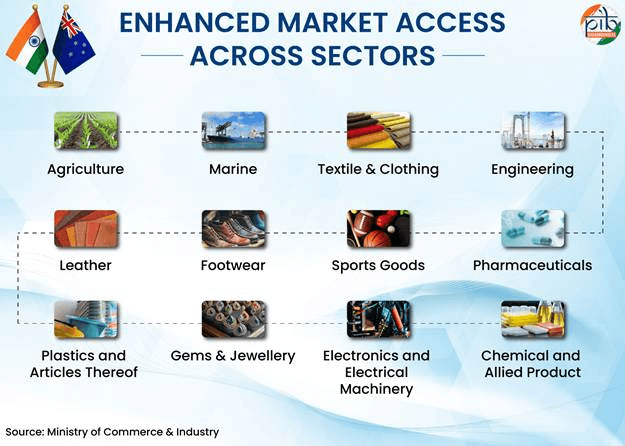
- The FTA boosts MSMEs and Jobs through Zero-duty access for labour-intensive sectors including textiles, apparel, leather, footwear, gems & jewellery, engineering goods and processed foods.
- India has offered market access in 70.03% of the tariff lines while keeping 29.97 % tariff lines in exclusion, which covers 95% of New Zealand’s Bilateral Trade.
- Certain products are kept in exclusion such as dairy (milk, cream, whey, yoghurt, cheese etc.), animal products (other than sheep meat), vegetable products (onions, chana, peas, corn, almonds etc.), sugar, artificial honey, Animal, vegetable or microbial fats and oils, Arms and Ammunition, Gems and Jewellery, Copper and Articles (Cathodes, Cartridges, Rods, Bars, Coils etc.), Aluminium and articles thereof (Ingots, billets, wire bars) among others.
- 30.00% of tariff lines will have immediate duty elimination, covering wood, wool, sheep meat, leather-raw hides etc.
- 35.60% of tariffs are subject to phased elimination over 3, 5, 7, and 10 years, including petroleum oil, malt extract, vegetable oils, and selected electrical and mechanical machinery, peptones etc.
- 4.37% of products face tariff reductions, such as wine, pharmaceutical drugs, polymers, aluminium, iron and steel articles etc
- 0.06% fall under tariff rate quotas, including Mānuka honey, apples, kiwi fruit, and albumins including milk albumin.
The India–New Zealand Free Trade Agreement reflects a defining moment in India’s trade diplomacy, opening new avenues for comprehensive economic cooperation. By securing improved market access for Indian goods, expanding opportunities in services and mobility, and deepening collaboration in agriculture, investment and emerging sectors, the Agreement delivers tangible and wide-ranging benefits across the economy.