
S N VERMA
Union Minister Jitendra Singh has announced that India is on course to become the second country after Russia to operate a commercial-level fast breeder reactor, marking a major advancement in its nuclear energy programme.
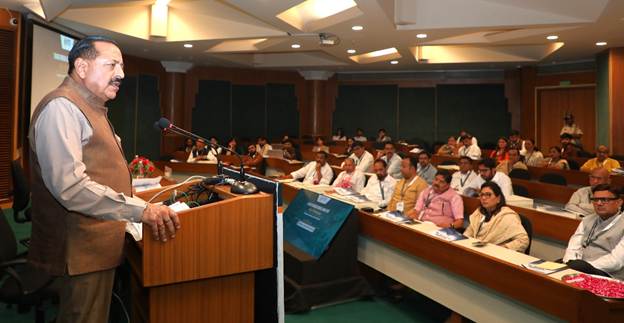
Addressing a workshop for MPs and MLAs on Small Modular Reactors (SMRs), the minister highlighted that India recently achieved a key milestone with the indigenously developed 500 MWe Prototype Fast Breeder Reactor (PFBR) at Kalpakkam, which attained first criticality on April 6, 2026.
The reactor has been designed by the Indira Gandhi Centre for Atomic Research (IGCAR) and constructed by BHAVINI. It represents the second stage of India’s three-stage nuclear power programme and uses uranium-plutonium mixed oxide fuel, enabling it to generate more fuel than it consumes.
Dr Singh noted that once fully operational, the reactor will place India among a select group of nations with advanced fast breeder reactor technology, a domain currently dominated by Russia. While countries such as the United States, United Kingdom, France, Japan, Germany, and China have experimented with similar technologies in the past, many of those programmes are no longer active.
He emphasized that the development of the PFBR is a crucial step toward unlocking India’s vast thorium reserves under the third stage of its nuclear strategy, thereby strengthening long-term energy security and sustainability.
The minister also underlined the growing importance of nuclear power in India’s clean energy transition, stating that it will be vital for achieving the target of 100 GW nuclear capacity by 2047 and meeting the country’s net-zero commitment by 2070. He added that emerging sectors such as artificial intelligence, data infrastructure, and advanced manufacturing would increasingly depend on reliable and continuous clean energy sources, where nuclear power would play a central role.
Highlighting future initiatives, Dr Singh spoke about the government’s push for Small Modular Reactors, supported by policy measures and legislative frameworks such as the SHANTI Act to encourage private sector participation. Under the recently launched “Nuclear Mission” with an allocation of ₹20,000 crore, India plans to develop five SMRs by 2033.
He noted that SMRs would be particularly useful for industrial applications, densely populated regions, remote areas lacking grid connectivity, and for repurposing existing thermal power plants.
Reaffirming the government’s vision, the minister said a balanced energy mix—combining nuclear, renewable, and other clean sources—would be essential for ensuring sustainable growth while addressing future energy demands.