
Last Updated on July 1, 2026 12:08 pm by BIZNAMA NEWS
Manan Kumar
India’s partition leading to the massacre of millions of people is a difficult subject to make a movie and cannot and should not be attempted with one broad brush with one underlying theme and paying scant attention to the socio-political events that led to it and unfolded along with it.
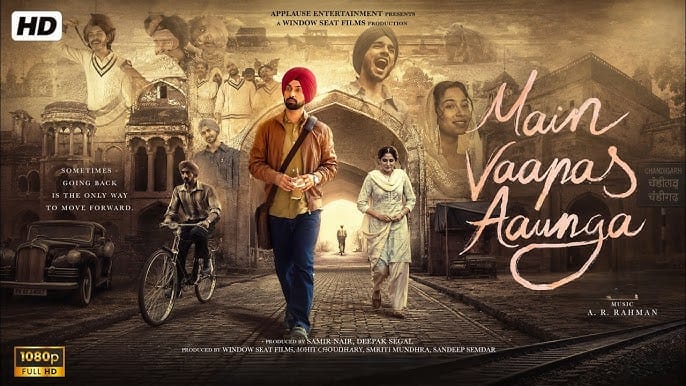
Main Vaapas Aaunga is one such typical Bollywood love story, full of adolescent melodrama shown in sepia trying to convey the hate, pain, yearning, longing and closure associated with partition.
The movie steers clear of the role played by the Muslim League, right wing Hindutva groups, and especially Master Tara Singh whose war cry in Lahore immediately caused trouble in Rawalpindi and elsewhere in Pakistan leading to massive riots.
Like most big budget Bollywood movies, Main Vaapas Aaunga clearly has a class angle. It shows only the story of two-three influential and rich families of Sargodha living in huge palatial houses, the struggles of the common man are nowhere to be seen.
The College scenes convey no serious thinking among the students of that era barring one very short scene of a Progressive Writers’ Association congregation. It seems the students had little knowledge of what was unfolding before them (ostensibly because of a lack of social media and other faster means of communication) and were having a carefree time. The truth as we know it, is the absolute opposite. Students in West Punjab were highly political, very well aware of the British moves and involved in several movements.
Certain dance songs attempting to depict the period were jarring because they mixed in moves performed in today’s Bollywood films. No hijab or burqa or women covering their heads with dupattas in the Sargodha and Lahore sequences was a huge cultural miss. Even my great-grandmother, who belonged to an influential and liberal family, used to wear a burqa or hijab in the bazaar and cover her head at home with a dupatta.
Naseeruddin Shah’s superb characterisation of a dementia stricken 90 plus years old man virtually anchors the movie but his Punjabi diction occasionally feels a bit off. Shah’s immersive acting does justice to the movie’s main essence: a physically wasted man refusing to die to find closure for the promise (“Main Vaapas Aaunga”) he gave to the Muslim girl, Afsana, whom he loved in his youth. His grandson Nivair (Daljit Dosanjh) helps find this closure by visiting Afsana’s house in Sargodha, Pakistan. Vedang Raina’s acting as the innocent bearded Nirvair and Sarvari’s as Afsana are average and at times jerky.
Perhaps the only saving grace of the movie is the song and images, including the Palestine bombardments, played during the end credits. Through this, Imtiaz Ali seems to be atoning for his visit to Israel where he shook hands with Netanyahu and declared that to him Israel is the Promised Land.
Overall, it is a tear-jerker movie that deserves two out of five stars but can be given three stars because of Shah’s presence. It’s good for Varun Dhawan fans, though they should be prepared for some gory scenes.