
SUDHIR KUMAR / NEW DELHI
In a landmark move charting the capital’s trajectory for the next two decades, the government today officially unveiled the Delhi Master Plan 2047. Designed to align with the national vision of Viksit Bharat 2047, the comprehensive blueprint provides a long-term spatial, economic, and institutional framework to transform Delhi into a world-class, environmentally resilient, and economically vibrant metropolis catering to an estimated population of 3.2 crore.
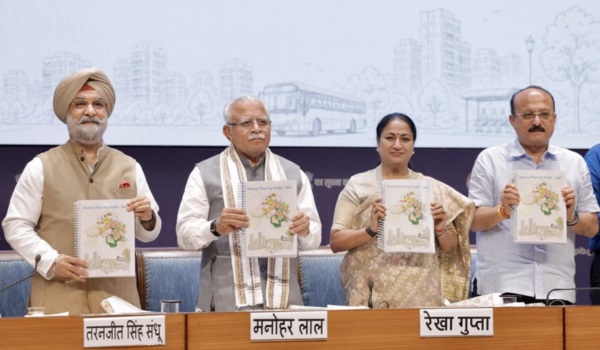
The unveiling ceremony, held in the capital, drew several key dignitaries, including Union Housing and Urban Affairs Minister Manohar Lal, Delhi Lieutenant Governor Taranjit Singh Sandhu, Delhi Chief Minister Rekha Gupta, and Delhi Urban Development Minister Ashish Sood, alongside senior bureaucratic leadership.
Dual Planning Approach for Balanced Growth
Spanning Delhi’s 1,484 square kilometers, the new Master Plan introduces a two-pronged strategy to navigate the city’s geographical limitations and development needs:
- Brownfield Redevelopment: Focusing on existing urban spaces, this approach prioritizes Transit-Oriented Development (TOD), mixed-use zoning, and robust infrastructure augmentation to revitalize mature areas.
- Greenfield Planning: Utilizing Right-of-Way (ROW) principles, undeveloped areas will leverage connected road networks driven by Land Pooling and Low-Density Policy frameworks to ensure seamless intra- and inter-city connectivity.
Union Minister Manohar Lal highlighted that the framework places people at the heart of urban design, paying special attention to the aspirations of youth, women, children, senior citizens, and persons with disabilities.
Key Pillars: Housing, Mobility, and Vertical Growth
Addressing the capital’s pressing housing demands, Minister Lal announced that around 40 lakh new affordable housing units will be added to the city in the coming years, featuring a significant share of standard residential options. A newly formulated TOD policy has also been introduced to bolster public transport corridors and mitigate traffic congestion.
Lieutenant Governor Taranjit Singh Sandhu noted that the plan draws inspiration from Prime Minister Narendra Modi’s ‘Sapt-Dhara’ vision. It lays out a definitive roadmap emphasizing vertical growth, quality housing, and the establishment of dedicated knowledge, education, and medical hubs, all while safeguarding Delhi’s rich historical and cultural heritage.
Chief Minister Rekha Gupta acknowledged the city’s unique administrative and spatial constraints, emphasizing that the plan delivers holistic development across rural pockets, unauthorized colonies, and formally planned zones alike. “Urban development has been meticulously structured to address Delhi’s rising transport demands, pollution challenges, and the housing needs of every economic class,” she stated.
Distinguished Presence
The high-profile launch event was attended by prominent administrative leaders, including Union Capital Development Secretary D. Thara, Delhi Chief Secretary Rajeev Verma, and Delhi Development Authority (DDA) Vice Chairman N. Saravana Kumar, underscoring a unified multi-agency commitment to executing the transformative vision for Delhi by 2047.