
By Our Correspondent
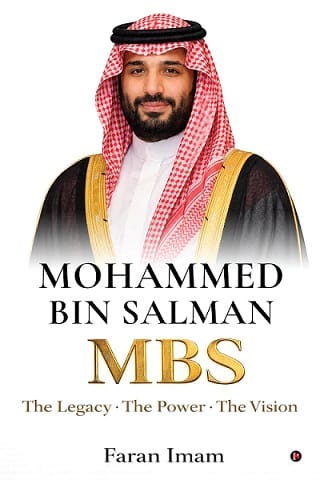
At a time when Saudi Arabia is rapidly redefining its economic priorities and geopolitical role, Mohammed bin Salman — MBS: The Legacy • The Power • The Vision by Faran Imam attempts to capture the personality, policies and ambitions of one of the world’s most closely watched leaders — Mohammed bin Salman. The book offers a broad political and economic examination of the Saudi Crown Prince’s leadership and the transformation unfolding within the Kingdom under his stewardship.
Stylistically, the book maintains a tone that is supportive of Mohammed bin Salman’s leadership and reform agenda. Readers looking for a strongly critical or adversarial political biography may find the perspective more favourable than balanced. However, the author appears transparent about the book’s central argument: that Mohammed bin Salman represents a transformative leader attempting to redefine the trajectory of Saudi Arabia in an era of global transition and regional uncertainty.
This perspective does not necessarily weaken the book; rather, it positions the work within a particular interpretive tradition of political leadership studies. Imam’s admiration for the scale of Saudi Arabia’s transformation is evident throughout the text, yet the book still provides valuable information regarding contemporary Saudi reforms, governance structures, and developmental policies.
The prose is straightforward and accessible, making the book suitable not only for specialists in Middle Eastern politics but also for general readers interested in global affairs, leadership, and economic transformation. The structure is organised and thematic, allowing readers to move through discussions of politics, economics, society, diplomacy, and institutional reform with relative ease.
This book tries to evaluate and feature Mohammed bin Salman (MBS) as more than a regional political figure, but rather as a transformational statesman whose policies have changed the nature of Saudi Arabia’s domestic institutions and transformed its position in the world. The book presents a political, economic, and leadership analysis of MBS’s leadership in the context of contemporary Saudi Arabia in a clear and understandable way.
Vision 2030, the ambitious reform program created by MBS, is one of the strongest pieces of information found in the book. Significant emphasis is placed on Vision 2030 and the agenda for economic diversification from Saudi Arabia’s traditional dependence on oil revenues. Author contends that Vision 2030 is not just an economic strategy but also represents a civilisational institutional remodelled Saudi Arabia in preparation for the challenges of the 21st century.
The chapter on economic modernisation is particularly strong. Major projects that are examined with respect to Saudi Arabia’s economic modernisation include infrastructure development, tourism diversification, foreign investment/investor policies, privatisation, and technological innovations. Imam assesses these reform efforts as part of an overall strategy to re-position Saudi Arabia as an important global economic and geopolitical force. Examples of giga-projects that are detailed include: NEOM, urban modernisation, and restructuring.
Importantly, the book arrives at a time when Saudi Arabia occupies an increasingly central role in international politics and economics. Questions surrounding energy transition, regional security, technological modernisation, and global investment have all elevated Saudi Arabia’s significance on the world stage. In this context, Imam’s work attempts to explain the intellectual and political framework behind the Kingdom’s current transformation.
Whether one fully agrees with the author’s conclusions or not, Mohammed bin Salman — MBS: The Legacy · The Power · The Vision succeeds in provoking discussion about leadership, modernisation, and the future direction of the Middle East. It is both a study of a political leader and a broader reflection on the challenges faced by states seeking rapid transformation in a changing global order.
For readers seeking an accessible and comprehensive overview of Mohammed bin Salman’s leadership era and Saudi Arabia’s ongoing reforms, this book provides a useful and thought-provoking contribution to the growing literature on contemporary Middle Eastern politics.
For readers interested in contemporary Saudi Arabia and the changing dynamics of the Middle East, Mohammed bin Salman — MBS: The Legacy • The Power • The Vision offers an informative and thought-provoking overview of one of the most consequential political figures of the present era.
Book is available at amazon and flipkart

About Author : Faran Imam is an independent researcher and analyst with a strong interest in Middle Eastern politics, political economy and contemporary governance. His work primarily explores questions of leadership, state transformation, institutional reform and strategic change in the modern Arab world, particularly during periods of rapid political, social and economic transition. Through his research and writing, he seeks to examine how emerging leadership models and policy reforms are reshaping the political and economic landscape of the region.