
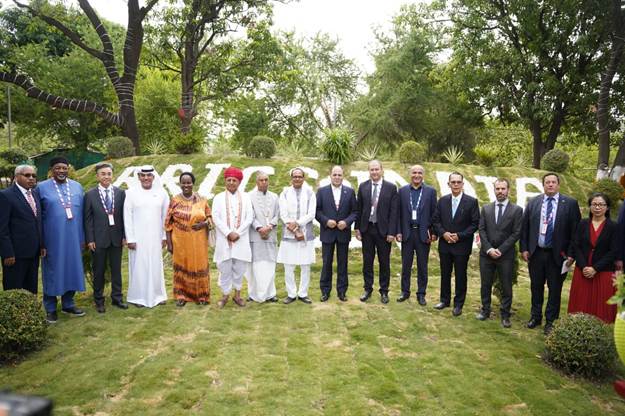
Our Correspondent / Indore
The BRICS Agriculture Ministers’ and officials-level meetings concluded in Indore with the unanimous adoption of the ‘Indore Declaration’, a landmark outcome document that seeks to reshape global cooperation in food security, farmer welfare, climate-resilient agriculture, agricultural trade and digital transformation of farming. The declaration is being viewed as a major step toward creating a more inclusive, sustainable and farmer-centric agricultural framework among BRICS nations.
Addressing a press conference after the conclusion of the meetings, India’s Union Minister for Agriculture and Farmers’ Welfare and Rural Development, Shivraj Singh Chouhan said the gathering sent a strong message of collective responsibility at a time when the world is facing multiple crises and uncertainties.
The meetings brought together nearly 60 foreign delegates from BRICS member and partner countries, with around 100 representatives participating overall. According to the minister, the scale of participation reflected the growing importance that BRICS nations place on agriculture and food systems.
Highlighting the bloc’s global significance, Chouhan said BRICS countries represent nearly half of the world’s population, account for around 42 per cent of global agricultural land and contribute close to 42 per cent of world foodgrain production. He said this collective strength gives BRICS increasing influence in shaping international agricultural priorities.
India, holding the BRICS Presidency this year, placed four major priorities at the centre of discussions — ensuring food security and nutritious diets, strengthening agricultural trade and cooperation, promoting regenerative and climate-resilient farming, and advancing innovation and technology partnerships in agriculture.
Special attention was also given to small and marginal farmers, often referred to internationally as family farmers. Delegates discussed issues including access to inputs, credit availability, fair pricing and stronger market connections.
The newly adopted Indore Declaration places farmers at the centre of agricultural development and records a shared commitment to improving food security, nutrition, livelihoods, trade, innovation, investment and sustainable farming systems. Chouhan said the declaration goes beyond a policy document and reflects a collective resolve to deliver tangible benefits to farmers and rural communities.
A key outcome of the meeting was the launch of four major institutional initiatives.
The first is the BRICS Network of Centres of Excellence on Agro-Ecology and Regenerative Agriculture, designed to support joint research, knowledge sharing and capacity building in natural and sustainable farming practices. India’s Indian Institute of Farming Systems Research, Modipuram, will play a major role under this network.
The second initiative is the BRICS Network on Digital Agriculture, which will promote cooperation in artificial intelligence, geospatial technologies, digital public infrastructure and data-driven agricultural solutions. Indian Institute of Technology Delhi will coordinate this network from India.
The third initiative establishes a Global Forum on Farmers’ Rights in Seed Systems, aimed at protecting indigenous seed diversity, preserving traditional knowledge and safeguarding farmers’ rights.
The fourth initiative, BRICS AgriN (Agro Inputs, Genetic Resources and Information Network), will strengthen cooperation on agricultural inputs, seed systems, information exchange and access to genetic resources.
Member countries also agreed to strengthen the existing BRICS Agricultural Research Platform and transform it into a stronger “Knowledge to Action Hub” to ensure research reaches farms more effectively.
The ministers reiterated support for a fair and transparent multilateral agricultural trading system and discussed mechanisms to improve agricultural trade and cooperation.
Climate change remained a central theme throughout the discussions. Delegates exchanged views on climate-resilient farming, regenerative practices, food loss reduction and preparedness for weather-related risks, including possible impacts of El Niño.
The meeting also highlighted the growing role of youth, women and agri-startups in transforming agriculture. Participants stressed that innovation, entrepreneurship and wider access to technology will be essential to building a smarter and more sustainable agricultural future.
Concluding the event, Chouhan praised Indore’s hosting and said the city had emerged as a new platform for global agricultural diplomacy, combining policy dialogue with cultural engagement and international cooperation.