
Staff Reporter / New Delhi
Farmers’ organisations have intensified their demands for urgent policy reforms, affordable seed access, and stronger public-sector support, as concerns grow over rising input costs and declining cotton productivity across India.
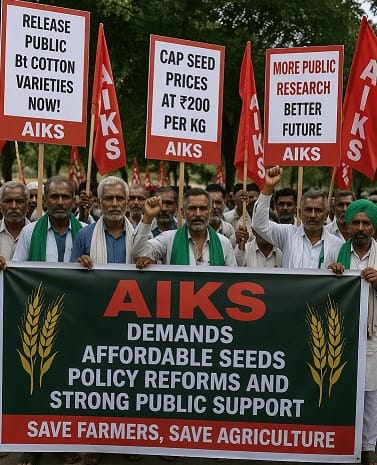
In a detailed statement, the All India Kisan Sabha (AIKS) highlighted the financial distress faced by millions of cotton farmers, attributing it to high seed prices, regulatory delays, and limited access to publicly developed Bt cotton varieties. The group stressed that farmers are being forced to depend heavily on expensive private hybrid seeds, which significantly increase cultivation costs.
According to AIKS, the cost of Bt cotton seeds has risen steadily in recent years, placing a heavy burden on farmers already grappling with falling cotton prices and increasing input expenses such as fertilizers, pesticides, and weed control. This imbalance, farmer leaders argue, is pushing many cultivators into debt and economic insecurity.
At the core of the farmers’ demands is the immediate release and large-scale distribution of publicly developed Bt cotton varieties. These varieties, developed by institutions like the Indian Council of Agricultural Research (ICAR) and state agricultural universities, are seen as a viable alternative because they allow farmers to reuse seeds for multiple seasons, significantly reducing recurring costs.
Farmers are also demanding that such public seed varieties be made available at highly subsidized rates, with AIKS proposing a price cap of ₹200 per kilogram. Additionally, they are calling for reforms in the regulatory approval process overseen by the Genetic Engineering Appraisal Committee (GEAC), which they claim delays the rollout of public-sector innovations while private players dominate the market.
Another major demand includes a substantial increase in government investment in agricultural research and development. Farmer groups have urged the Centre to double R&D spending to at least 1% of agricultural GDP, ensuring sustained innovation and support for public institutions.
Beyond pricing and research, AIKS has also called for a comprehensive relief package for distressed farmers. This includes debt relief measures, compensation of ₹20 lakh for families affected by farmer suicides, and long-term livelihood support initiatives.
The organisation further urged the government to launch a ₹5,000 crore national mission aimed at boosting cotton productivity, alongside an investigation by the Competition Commission of India into alleged anti-competitive practices in the seed sector.
As the debate intensifies, farmers across cotton-growing regions are demanding swift government intervention, warning that without structural reforms and affordable inputs, the crisis in the sector could deepen further.