
BIBHUDATTA PRADHAN / NEW DELHI
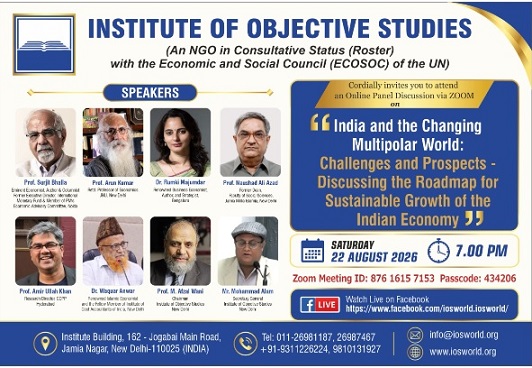
As geopolitical fault lines redraw global trade and strategic rivalries strain traditional supply chains, the Institute of Objective Studies (IOS) convened leading economists, academics, and policymakers on Saturday, August 22, to forge a definitive economic blueprint.
Against a backdrop of surging protectionism and technological disruption, the high-level symposium—titled “India and the Changing Multipolar World: Challenges and Opportunities—A Roadmap for the Sustainable Development of the Indian Economy”—tackled the central paradox facing the nation: how to leverage its demographic dividends and strategic market power to drive resilient, inclusive growth.
Chaired by Professor Muhammad Afzal Wani and moderated by Sheikh Nizamuddin, the deliberations brought together prominent voices including Professor Surjit Bhalla, Professor Arun Kumar, and Professor Naushad Ali Azad. Speakers emphasized that navigating an increasingly fractured global order requires India to simultaneously fortify its domestic economic foundations and aggressively diversify its international partnerships.
In his introductory remarks, IOS Secretary General Mr. Muhammad Alam said that the world is passing through a period of profound geopolitical and economic transformation. The old assumptions of a relatively stable global economic system are facing challenges due to strategic rivalries, conflicts, trade tensions, technological competition, disruptions in supply chains, energy insecurity, and growing protectionism.
Against this backdrop, he said, India’s emergence as a major economy presents both unprecedented opportunities and formidable challenges. The central question before policymakers and economists is how India can transform its demographic strength, expanding market, technological capabilities, and strategic location into sustainable, inclusive, and resilient economic growth.
The discussion emphasized that the emerging multipolar world is characterized not merely by the rise of new centers of political power, but also by a fundamental restructuring of global production, trade, technology, finance, and energy relations. Economic interdependence is increasingly being viewed through the prism of national security and strategic competition. Against this changing backdrop, the speakers broadly agreed that India needs to strengthen its domestic economic foundations while simultaneously expanding and diversifying its global partnerships.
Professor Surjit Bhalla drew attention to the need for India to assess its economic performance not only in comparison with other major economies but also in relation to its own enormous potential and long-term national aspirations. He emphasized that India has demonstrated considerable resilience and is among the world’s major growth centers. However, if the country is to fulfill its ambition of becoming a developed economy, the pace of growth needs to be accelerated substantially.
He stressed the importance of sustaining high growth, increasing investment, creating employment, and raising productivity. He suggested that India must translate improvements in infrastructure, human capital, and macroeconomic stability into a significantly higher and more sustainable rate of growth.
Policy reforms and more effective utilization of the country’s economic and demographic potential were essential to achieving this objective.
Professor Bhalla’s intervention brought the discussion back to a fundamental question: Is India growing in line with its capabilities and its aspirations for the future? The challenge, therefore, is not simply to sustain growth, but to create conditions for faster, broader, and more productive growth.
Professor Arun Kumar focused on the structural dimensions of the Indian economy and the need to look beyond overall macroeconomic indicators. He emphasized the importance of employment, purchasing power, inequality, the informal sector, and the condition of small and medium-sized enterprises in assessing the real health and sustainability of economic growth.
He stressed that a sustainable growth strategy must ensure that the benefits of development reach broader sections of society. Sustainable economic expansion, he noted, cannot depend solely on the performance of a few sectors or large corporations. It requires broad-based employment generation, strengthening domestic demand, and greater support for the productive sectors of the economy.
Professor Kumar’s observations highlighted the close relationship between growth, employment, and equality. He suggested that India’s roadmap should address structural weaknesses while promoting production. Greater investment, technological advancement, and maximum participation of the population in the development process are required.
Professor Naushad Ali Azad examined the issue in the broader context of the relationship between social development, economic development, and social transformation. He emphasized that economic policy cannot be separated from questions relating to education, human development, social justice, and the empowerment of different sections of society.
Meanwhile, Professor Amir Ullah Khan highlighted the centrality of human development to India’s future economic prospects. He stressed the importance of quality education, skill development, healthcare, employment, and financial inclusion in building an economy capable of sustaining long-term growth.
Dr. Romki Majumdar, speaking about the challenges and opportunities facing Indian businesses and industry amid increasing global uncertainty, pointed to the growing importance of resilience, diversification, and adaptability in a world affected by geopolitical tensions, supply-chain disruptions, technological changes, and fluctuations in international markets.
He emphasized the need to strengthen India’s competitiveness through improvements in infrastructure, the investment climate, technological capabilities, and ease of doing business.
In the same context, Dr. Waqar Anwar emphasized the need to adopt an important ethical and alternative economic perspective. He highlighted the importance of values such as equity, social responsibility, fiscal prudence, and the broader welfare of society in shaping a sustainable economic order.
He stressed that discussions on growth should not be limited merely to the expansion of GDP. Questions concerning the equitable distribution of wealth, productive investment, financial inclusion, and the protection of vulnerable sections of society are equally important.
IOS Chairman Professor Afzal Wani emphasized the importance of serious and sustained intellectual engagement with the economic and strategic challenges facing India. He observed that the transformation of the global system requires India to formulate policies that are economically robust, socially responsible, and responsive to rapidly changing international realities.