
Last Updated on December 3, 2025 11:48 pm by BIZNAMA NEWS
– Lalit Gargg –
Russian President Vladimir Putin’s visit to India is not a routine diplomatic engagement; it is a renewed proclamation of a friendship woven and fortified over seven decades. International politics is often said to have no permanent friends or enemies—only permanent interests. Yet the India-Russia relationship transcends this logic, emerging as a symbol of enduring trust, moral obligation, and mutual respect.
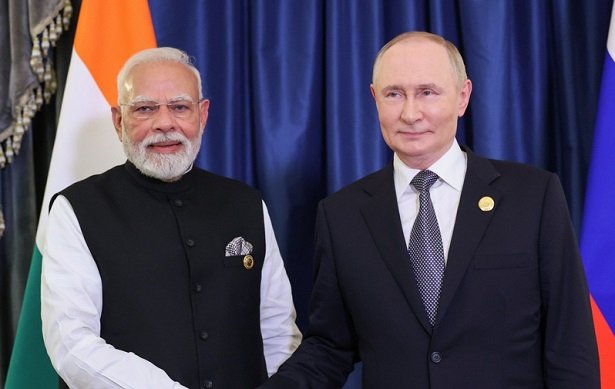
This visit comes at a time when Western nations—particularly the United States, Europe, and the NATO bloc—have imposed harsh economic and strategic sanctions on Russia. Despite this, India not only extended diplomatic respect to Moscow but also upheld it as the most reliable partner in energy and defence cooperation. Thus, this summit between President Putin and Prime Minister Narendra Modi is more than a bilateral meeting—it signals the dawn of a new era and the stirrings of fresh global geopolitical equations.
The roots of India-Russia friendship run nearly seventy years deep. During the Cold War, the Soviet Union defended India’s sovereignty and security interests on key international platforms. From the Bangladesh Liberation War to the Pokhran nuclear tests, Moscow stood firmly with New Delhi. Today, as the Ukraine conflict polarises the world and Western pressure mounted on India to distance itself from Russia, New Delhi upheld its strategic autonomy and maintained its partnership. By purchasing record quantities of Russian oil and gas despite sanctions, India not only secured its energy needs but also provided Moscow economic support. This was not merely commercial—it was a statement of independent foreign policy.
Russia, in turn, has never disappointed India. From the S-400 air defence system and T-90 tanks to the BrahMos missile programme and cooperation on fifth-generation fighters, Russia has played a decisive role in strengthening India’s military capability. Moscow has also aligned with New Delhi’s security concerns, offering quiet backing against Pakistan and extending cooperation in sensitive missions like “Operation Sindoor.” These facts reflect the depth and credibility of bilateral trust. The Modi–Putin dialogue arrives at a moment of global flux—U.S.–China tensions, the Ukraine conflict, Western sanctions, energy volatility, and an anti-Russia Western front. In this landscape, India is emerging as mediator, balancer, and an independent axis. For Putin, India is not just a defence partner but a stabilising pillar in Asian geopolitics. Modi’s foreign policy embraces a multipolar world narrative in which Russia remains central.
Energy ties are set to deepen. As the world’s third-largest energy consumer, India views Russia as a dependable supplier offering affordable, long-term support. Moscow’s willingness to sustain supplies despite sanctions carries friendship as well as strategic value. In defence, cooperation is expected to expand further. India’s goal of indigenous military production finds Russia its largest collaborator—whether in BrahMos, assault rifle manufacturing, spare supplies, or new joint-development programmes. Moscow not only supplies India—it empowers its defence industry, signalling maturity in partnership. India-Russia relations are poised to script a new chapter. Even during phases when New Delhi deepened ties with the U.S., Moscow remained a steadfast ally. Once again, Putin’s visit promises renewed warmth and emerging avenues of cooperation. Russia has even drafted a proposal to employ nearly one million skilled Indian workers in its industries—an unprecedented gesture in bilateral labour cooperation. At the heart of this relationship lies diplomatic trust and respect. Russia has never interfered in India’s internal affairs and consistently supported India’s positions on Kashmir, nuclear policy, strategic autonomy and regional disputes. India has reciprocated by understanding Russia’s security anxieties—from NATO expansion to the Ukraine conflict—advocating dialogue and peaceful resolution despite Western pressure.
Russia’s contribution extends far beyond defence—to space science, nuclear energy, research, medicine and education. India’s early space missions owed much to Moscow, and prospects of cooperation in astronaut-carrying programmes remain strong. Cultural ties too are rich—yoga, Ayurveda, literature, performing arts and Russian theatre have found a place across societies. Yet challenges remain. Russia’s growing closeness with China complicates India’s strategic space, just as India’s deepening ties with the U.S. challenge Moscow. Issues of technology transfer, production delays and payment mechanisms persist. But the willingness to resolve differences through dialogue reflects maturity. The importance of Putin’s visit lies in reaffirming that India shapes its foreign relations not under global pressure but on national priorities. For energy security, defence self-reliance, a multipolar order and Asian strategic balance—India-Russia engagement remains essential. The Modi–Putin meeting testifies that this partnership is rooted not merely in Cold War nostalgia, but in evolving interests and forward-looking strategy.
The visit stands as a symbol—of sovereign diplomacy, strategic partnership and civilisational respect. India-Russia relations are not merely bilateral—they represent the emergence of an alternative global power architecture. Despite Western criticism and sanctions, both nations have not only preserved their ties—they have deepened them. This summit promises new momentum to India’s energy security, boosts domestic defence manufacturing, expands trade and technological cooperation and strengthens strategic confidence. Modi and Putin remind the world that geopolitics rests not only on rivalry but on trust and collaboration. Thus, Putin’s visit marks the beginning of new energy, fresh perspectives and future-shaping partnerships—where India and Russia are not just friends, but architects of a balanced, independent and multipolar world order. It is a new chapter where an old trust gives birth to a new future.
Lalit Gargg is Writer, Journalist, Columnist