
AMN / PUNE
The Leader of Opposition in the Lok Sabha Rahul Gandhi on Saturday highlighted the courage of young women who have continued to raise their voices despite facing alleged abuse, verbal harassment and violence, saying their voices can no longer be silenced.
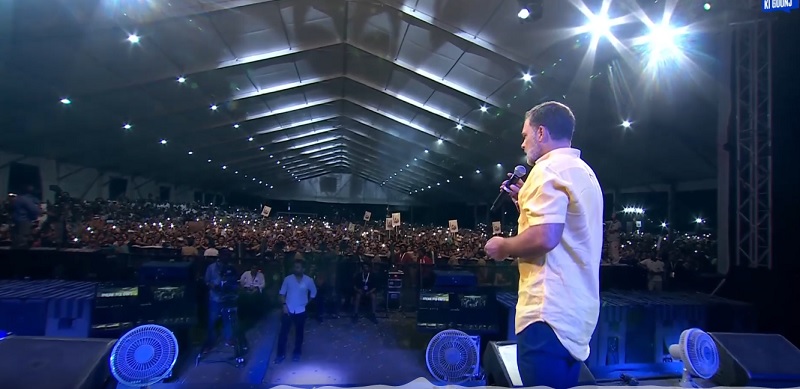
Addressing the Chhatron Ki Goonj programme in Pune, Gandhi said he was proud of the country’s youth, particularly young women who had spoken up despite intimidation and opposition. “Now their voices cannot be suppressed. Girls will speak and the country will listen,” he said.
The programme was organised specifically to provide female students a platform to discuss issues affecting their education, safety, equality, competitive examinations, employment and future opportunities. Gandhi used the interaction to emphasise the importance of greater participation by young women in public life and in shaping India’s future.
He said women should have the freedom to make decisions about their own lives without being dependent on others. Describing women as one of India’s greatest strengths, Gandhi argued that the country’s economic and social progress would remain incomplete without their equal participation.
Focus on education, jobs and safety
The Congress leader’s interaction with students touched upon several concerns facing young people, including alleged paper leaks and irregularities in competitive examinations, rising education costs, employment opportunities, women’s safety and equal access to opportunities.
Gandhi urged young people to question policies and systems that affect their future and to raise their concerns through democratic means. He said the participation of the younger generation was essential for building a stronger and more inclusive India.
He also criticised traditional and discriminatory ideas concerning women, referring to the Manusmriti and arguing that women must be treated with equal dignity and rights. Gandhi called on the younger generation to challenge ideas that perpetuate inequality and restrict women’s freedom.
During the programme, Gandhi also highlighted what he described as the multiple forms of pressure and discrimination faced by women in everyday life. He argued that society often attempts to control women through restrictions, humiliation and violence, sometimes presenting such restrictions as concern for their safety.
Some of the figures cited during his address related to women’s mobility, violence, education, marriage and property ownership. These claims, however, would require independent verification before being treated as established national statistics.
Tensions before the event
The programme took place amid reports of tension between student groups associated with the Akhil Bharatiya Vidyarthi Parishad (ABVP) and the National Students’ Union of India (NSUI).
The reported confrontation occurred outside a hostel of COEP Technological University in Pune, with both sides levelling allegations against each other.
Pune Police had granted permission for the programme subject to 30 conditions. The restrictions reportedly included a ban on objectionable images, banners and posters, along with directions to maintain discipline and ensure that religious sentiments were not hurt.
BJP questions programme
The event also triggered a political response from the BJP. The party questioned the nature of the gathering and reportedly referred to it as “Paise Ki Goonj”, alleging that social media influencers had been paid to attract crowds.
The Congress rejected the allegations, maintaining that the programme reflected growing support for Gandhi among young people and students.
The event was also attended by Bhojpuri folk singer Neha Singh Rathore, who spoke about the criticism and abuse she said women face when they question the government and political leadership.
Gandhi’s Pune programme comes as political parties increasingly seek to strengthen their engagement with young voters, particularly students and first-time voters. By focusing specifically on young women and issues such as education, employment, safety and equality, the Chhatron Ki Goonj initiative represents an effort to build a direct political connection with a younger generation.
The Pune event thus combined a discussion on women’s rights and student concerns with a broader political outreach campaign, placing the voices and aspirations of young women at the centre of Gandhi’s message.