
Last Updated on May 25, 2026 1:38 pm by BIZNAMA NEWS
By Andalib Akhter / Santosh Kumar Pathak
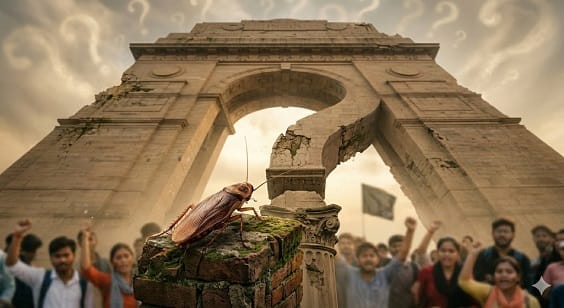
Truth is often stranger than fiction, and modern social media has made it even more unpredictable. In a country where political movements are traditionally built around nationalism, religion, caste, or ideology, a bizarre new phenomenon has suddenly captured the public imagination: thousands of young Indians proudly calling themselves “cockroaches.” What began as an angry reaction to a controversial courtroom remark has rapidly transformed into a viral digital campaign, complete with memes, hashtags, and a satirical political platform named the “Cockroach Janata Party.” Within days, the campaign exploded across Instagram, X, and YouTube, attracting millions of followers and massive media attention.
Within days, the campaign exploded across Instagram, X, and YouTube, attracting millions of followers and massive media attention. Supporters claim it represents the frustration of unemployed and ignored youth, while critics suspect it may be a carefully engineered political experiment designed to manipulate public anger. The speed of its rise, the mystery surrounding its founders, and the unusual media amplification have all raised uncomfortable questions: Is this truly a grassroots democratic movement, or is it another sophisticated political narrative crafted for hidden interests? In an era where digital perception often shapes political reality faster than facts themselves, the emergence of the “Cockroach Janata Party” deserves closer scrutiny.
On May 15, during the hearing of a case, Chief Justice of India Justice Suryakant used language and a tone that linked unemployed youth with “cockroaches,” triggering a nationwide storm. Although Justice Suryakant clarified his remarks the very next day, the protests and criticism did not subside.
While millions of youth frustrated with the government system were already expressing their anger in different ways, an Indian youth named Abhijeet Deepke — originally from Chhatrapati Sambhajinagar in Maharashtra and reportedly sitting far away from Delhi — came up with an idea and quickly created the “Cockroach Janata Party” on social media platforms. What followed appeared to be something unprecedented in Indian democracy.
Within a short period, the “Cockroach Janata Party” Instagram account was on the verge of reaching 23 million followers. This is almost two-and-a-half times more than the 9.3 million Instagram followers of the Bharatiya Janata Party, which claims to be the world’s largest political party.
Meanwhile, the party’s founder Abhijeet Deepke also remained constantly in the spotlight. At one point, the party’s X (formerly Twitter) account was allegedly restricted, and at another, claims surfaced that its website had been taken down. As people began investigating the background and origins of the party, Deepke appeared shaken and immediately started issuing clarifications. During this period, he also claimed that the party’s official Instagram page had been hacked. Once the account was restored, controversy deepened further when the party was found to have unfollowed its own controversial founder, Meghnanda.
All this suggests that something is clearly amiss. Something appears to be happening behind the scenes that is not immediately visible but can certainly be sensed. The BJP describes the party as a toolkit operated by opposition forces from foreign soil, while several senior journalists and intellectuals portray it as the BJP’s “B-team.” Many of Abhijeet Deepke’s actions have also raised suspicion — such as selectively giving interviews only to journalists perceived as supporters of a particular political camp, unfollowing controversial figures, following a select group of journalists, and later unfollowing them as well.
One must consider that a person so selective from the very beginning is unlikely to be acting alone. There may be a larger team or a sophisticated strategy behind it — one that deeply understands the psychology of democratic movements in India, as well as the functioning of both mainstream media and new media platforms such as YouTube channels.
Both the BJP and the Aam Aadmi Party have mastered the art of creating a political atmosphere through movements and campaigns. Unfortunately, the Congress Party — the country’s oldest political party, which ruled India for decades and is currently the largest opposition party — appears to have forgotten how to run and popularize mass movements on a large scale.
It is also worth noting that while some prominent journalists are giving significant space to the Cockroach Janata Party on their YouTube channels, mainstream media is offering it even greater coverage. Try recalling when such extensive attention was last given to a newly emerging political phenomenon.
It is worth remembering that even during the Anna Hazare–Arvind Kejriwal movement, anyone who questioned the movement was quickly labeled corrupt. Similarly today, if someone raises questions about the Cockroach Janata Party, a particular ecosystem of people — including journalists — immediately comes forward to question that person’s loyalty and ask, “What problem could anyone possibly have with the Cockroach Janata Party?”
But such people often forget the old saying: “Once bitten, twice shy”. After all, the first condition of democracy is the freedom to ask questions, and no one can be above questioning. Whenever any leader or organization tries to place itself beyond scrutiny, it sends only one message — that its intentions may not be entirely clean.
It is absolutely true that there is widespread anger among people, especially the youth, regarding the functioning of the government. However, India has seen such situations before, where the anger of young people was used by certain individuals to advance their own political interests. Such leaders showed youth dreams of a golden future and made grand, attractive promises that were never easy to fulfill. Therefore, this time, the people of India — especially the youth — need to remain cautious. Any campaign seeking to bring change in the country should emerge from Indian soil itself. Before blindly trusting any new organization, movement, or leader, people should ask themselves one crucial question: *Which political party or leader stands to gain the most from this new campaign, movement, or organization?*