
ANDALIB AKHTER
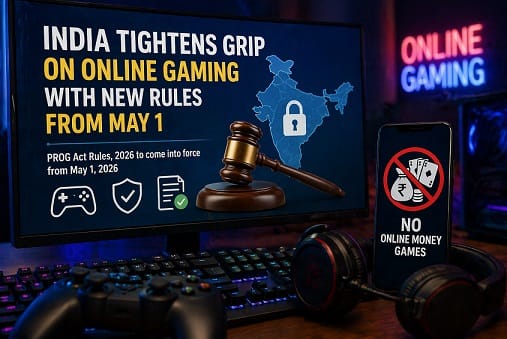
India is set to implement a comprehensive regulatory framework for the online gaming sector, with new rules under the Promotion and Regulation of Online Gaming (PROG) Act, 2025 scheduled to come into force from May 1, 2026. The move marks a significant step in balancing industry growth with consumer protection in one of the fastest-growing digital segments.
The PROG Act, passed by Parliament in August 2025, is designed to address the rising concerns associated with online money gaming, while simultaneously fostering a supportive ecosystem for e-sports and non-monetary online games. The legislation reflects the government’s dual objective of promoting innovation and safeguarding users from financial risks, addiction, and other social harms linked to unregulated gaming platforms.
The initiative aligns with the broader vision articulated by Narendra Modi to position India as a global hub for gaming, digital innovation, and creative industries. At the same time, policymakers have emphasized the need to curb exploitative practices in online money gaming, which have been increasingly flagged for their impact on vulnerable users.
To operationalize the Act, the Ministry of Electronics and Information Technology (MeitY) has formulated detailed rules under Section 19, which empowers the central government to frame regulations for effective implementation. These rules—titled the Promotion and Regulation of Online Gaming Rules, 2026—outline the compliance framework, operational guidelines, and safeguards required for gaming platforms operating in India.
Purpose of the Rules
The Rules are the operational architecture of the parent Act. Their purpose is to:
- provide a clear, transparent and time-bound mechanism to determine whether an online game is an online money game (and therefore prohibited) or a permissible online social game or e-sport;
- establish the Online Gaming Authority of India as a unified, digital-first regulator for the sector;
- create a statutory registration regime for e-sports and such categories of online social games as may be notified;
- prescribe mandatory user safety features, grievance redressal and transparency obligations for online game service providers;
- lay down the procedure for inquiry and imposition of civil penalties under section 12 of the Act; and
- provide an appellate mechanism to ensure accountability, fairness and observance of the principles of natural justice.
Guiding Policy Objectives
- Protecting citizens, especially children and vulnerable users, from the harms of online money gaming, addictive design and misleading promises of quick wealth;
- Ensuring regulatory certainty for the industry through clear criteria for determination, predictable timelines and a digital-first process;
- Safeguarding the financial system by preventing banks, payment systems and financial institutions from facilitating transactions linked to prohibited online money games;
- Enabling coordinated enforcement between the Authority, financial regulators, law enforcement agencies and State Governments; and
- Upholding user rights through a functional, two-tier grievance redressal mechanism and a statutory right of appeal.
The Regulatory Framework at a Glance
The Rules are organised into 6 Parts and 26 Rules covering the following pillars of the regulatory framework:
1. Online Gaming Authority of India (Part II, Rules 3–7)
- The Online Gaming Authority of India is constituted as an attached office of MeitY with its head office at the NCT of Delhi.
- It is structured as a compact, multi-sectoral body chaired by the Additional Secretary, MeitY (ex officio), with JS-level representatives from the MHA, Finance (Department of Financial Services), MIB, Youth Affairs and Sports, and Law and Justice (Department of Legal Affairs).
- The Authority is designed to function, as far as practicable, as a digital office.
- Functions include: maintaining and publishing the list of online money games, inquiring into complaints, issuing directions, orders and codes of practice, entertaining appeals against decisions of service providers on grievances, and coordinating with financial institutions and law-enforcement agencies for effective enforcement.
2. Determination of an Online Game (Part III, Rules 8–11)
- The Rules prescribe a determination test to classify whether an online game constitutes an online money game. Determination is triggered in three situations:
- suo motu action by the Authority;
- an application by a service provider offering the game as an e-sport;
- or a notification by the Central Government requiring a category of social games to be determined.
- Rule 9 lists objective factors for determination — payment of fees or stakes, expectation of monetary winnings, the structure of the revenue model, and the manner in which rewards or in-game assets are redeemed or monetised outside the game.
- Determination shall, as far as practicable, be completed within 90 days of a complete application or of notice issued in a suo motu proceeding (Rule 10).
- The outcome is recorded in a determination order, which is specific to the particular game and provider.
3. Registration of Online Games (Part IV, Rules 12–19)
- Registration is required ONLY where the Central Government so notifies — having regard to risk to users (including children), scale of participation, financial transactions and country of origin — and for every online game intended to be offered as an e-sport.
- On successful determination and registration, the Authority issues a digital Certificate of Registration with a unique registration number, valid for a period of up to 10 years.
- An online money game shall not be eligible for recognition or registration as an e-sport under the National Sports Governance Act, 2025.
- Registered service providers are required to prominently display the details of determination or registration on the interface through which the game is offered, designate a point of contact, comply with data retention directions, and observe directions issued in relation to facilitation of payments.
4. User Safety Features
- Rule 2(1)(i) introduces the concept of user safety features — technical, procedural, operational, behavioural or system-related safeguards appropriate to the risk profile of the game.
- These include age verification and age-gating, time restrictions, parental controls, user reporting tools, counselling support, and fair-play and integrity monitoring. Service providers are required to disclose their user safety features and internal grievance mechanisms at the time of application for determination or registration (Rule 23).
5. Two-Tier Grievance Redressal and Appellate Mechanism (Rules 7 and 20)
- Every online game service provider offering an online social game or e-sport must establish and maintain a functional grievance redressal mechanism.
- A user dissatisfied with the provider’s resolution (or in case of non-redressal) may approach the Authority within 30 days, which shall endeavour to dispose of the appeal within a further 30 days.
- A second appeal lies before the Appellate Authority i.e., the Secretary, MeitY who shall dispose of appeals, as far as possible, within 30 days of receipt.
6. Penalties and Enforcement (Part V, Rules 21–22)
- Proceedings are to be conducted in digital mode unless physical presence is deemed necessary, and concluded within 90 days of receipt of a complaint.
- Penalties are to be proportionate, with the Authority required to consider factors such as gain from non-compliance, loss caused to users, recurrence, gravity and mitigation efforts.
For details, please refer to the Gazette of India CG-DL-E-22042026-271974 dated 22 April 2026.