
Last Updated on June 1, 2026 10:19 pm by BIZNAMA NEWS
R. Suryamurthy
As India seeks to emerge as a global hub for clean-energy innovation, NTPC used Myanmar President Min Aung Hlaing’s visit to its research and development centre to showcase technologies that could shape the next phase of energy cooperation in the region.
The visit to NTPC Energy Technology Research Alliance (NETRA), the power utility’s R&D arm, offered a glimpse into how India’s largest power producer is preparing for a future increasingly driven by renewable energy, green hydrogen and advanced energy storage systems.
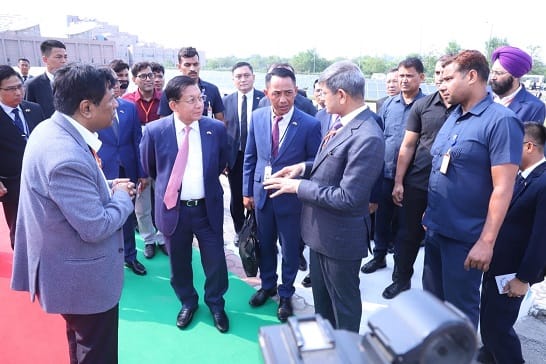
Accompanied by a high-level ministerial delegation, the Myanmar President was briefed on NTPC’s transformation from a conventional thermal power generator into a diversified energy company with growing investments in low-carbon technologies. Discussions also covered NTPC’s past engagements in Myanmar and the potential for future collaboration.
The timing of the visit is significant. Across Asia, governments are grappling with the twin challenge of expanding electricity access while reducing carbon emissions. Technologies being developed at NETRA are designed to address both concerns by improving grid flexibility, enhancing energy security and reducing dependence on fossil fuels.
The delegation visited several pilot facilities, including a solar microgrid, a vanadium redox flow battery energy storage system, a green hydrogen hub and a plant that converts agricultural and municipal waste into electricity. Together, these projects represent technologies that are increasingly being viewed as essential building blocks of future energy systems.
Officials familiar with the visit said the Myanmar side showed particular interest in solutions that could be adapted to local conditions, especially in areas where decentralised power generation and energy storage can improve reliability and expand access to electricity.
For NTPC, the visit highlighted a broader ambition. Beyond meeting India’s own energy transition goals, the company is positioning itself as a source of technology, expertise and project-development capabilities for developing economies seeking practical pathways toward cleaner energy.
NETRA has emerged as a key component of that strategy. The centre is currently advancing research and demonstration projects in green hydrogen, battery storage, pumped hydro, waste-to-energy systems and other carbon-neutral technologies that could eventually find applications beyond India’s borders.
While the visit did not result in any immediate announcements, it reflected a growing interest among neighbouring countries in India’s clean-energy ecosystem. As regional demand for sustainable power solutions rises, technology partnerships and knowledge-sharing initiatives are likely to become increasingly important elements of India’s energy diplomacy.
The engagement also underscored the role state-owned enterprises such as NTPC are expected to play in projecting India’s technological capabilities and supporting the country’s expanding influence in the emerging global clean-energy economy.