
Last Updated on June 1, 2026 10:10 pm by BIZNAMA NEWS
By R. Suryamurthy
India’s Comprehensive Economic Partnership Agreement (CEPA) with Oman came into force on Monday, marking another milestone in New Delhi’s aggressive free trade agenda. While the government has presented the pact as a major export and employment booster, analysts argue that its true significance lies elsewhere.
Rather than transforming trade volumes with Oman’s relatively small domestic market, the agreement is increasingly being viewed as a strategic hedge against geopolitical risks in the Gulf, offering India a more secure route for energy supplies and trade flows at a time when tensions around the Strait of Hormuz continue to threaten global commerce. The deal strengthens India’s access to a key maritime partner whose ports remain largely outside the vulnerable chokepoint, potentially enhancing the country’s long-term energy security and supply-chain resilience.
While the government has projected the agreement as a transformative trade pact that will boost exports, create jobs and deepen India’s integration into Gulf markets, trade analysts argue that its greatest value may lie less in immediate commercial gains and more in strengthening India’s long-term energy security and supply-chain resilience.
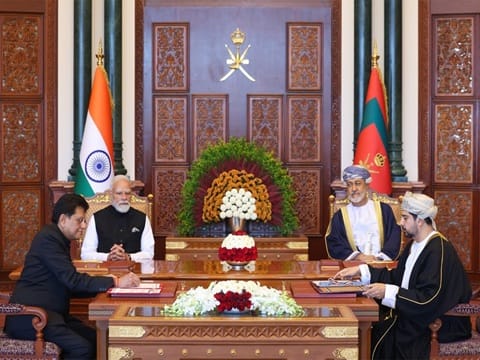
The agreement, signed in Muscat in December 2025, is India’s fifth free trade agreement implemented in the past five years and the fifteenth overall. It grants Indian goods zero-duty access on 98 percent of Oman’s tariff lines, covering more than 99 percent of India’s exports by value.
Commerce Minister Piyush Goyal described the pact as a “force multiplier” for India’s engagement with the Gulf region, highlighting benefits for exporters, professionals, farmers and small businesses.
Yet economists caution that Oman, with a population of just 5.5 million and a GDP of roughly $110 billion, is unlikely to become a major export destination in the way larger Gulf markets such as Saudi Arabia or the United Arab Emirates have.
“The importance of the agreement lies in Oman’s location rather than the size of its market,” said Ajay Srivastava in an analysis released by the Global Trade Research Initiative (GTRI).
Unlike most Gulf states, much of Oman’s coastline lies outside the Strait of Hormuz, the narrow waterway through which roughly one-fifth of global oil shipments pass. Ports such as Salalah and Duqm remain accessible even if shipping through the Strait is disrupted by conflict or geopolitical tensions.
Recent developments in the Gulf have underscored that advantage.
According to GTRI, India’s imports from major Gulf economies fell sharply from around $15 billion in April 2025 to $9.8 billion in April 2026 amid regional tensions, while exports to the region declined from $4.4 billion to $2.7 billion. Oman was the exception. India’s imports from Oman surged 246.4 percent, rising from $430 million to nearly $1.5 billion, driven by increased purchases of crude oil and urea, while exports to Oman declined by only 10.3 percent.
“The experience shows that Oman can act as a dependable alternative trade and energy gateway for India when the Strait of Hormuz becomes risky or congested,” the report said.
That strategic dimension appears increasingly important as India seeks to diversify supply routes and secure access to critical energy resources amid growing geopolitical uncertainty stretching from the Red Sea to the Gulf.
The CEPA strengthens India’s access to Omani crude oil, liquefied natural gas (LNG), fertilizers and industrial feedstocks. India imported goods worth $7.2 billion from Oman in FY2025-26, including $1.6 billion of crude oil, $1.2 billion of LNG and $843 million worth of fertilizers. Oman also supplied $465 million of methanol and $424 million of ammonia, key inputs for Indian industry.
The agreement therefore reinforces a relationship that is as much about securing strategic supplies as expanding merchandise trade.
On the export side, Indian shipments to Oman totaled around $4 billion in FY2025-26. Refined petroleum products dominated exports, including petrol worth $781 million and naphtha worth $746 million, followed by calcined alumina, engineering goods, machinery, iron and steel products and rice.
Government officials argue that tariff elimination will create fresh opportunities for labour-intensive sectors such as agriculture, marine products, textiles, gems and jewellery, pharmaceuticals, engineering goods and automobiles. The agreement also includes broad commitments on services trade and professional mobility, areas where India enjoys a comparative advantage.
However, trade experts note that more than 80 percent of India’s exports to Oman were already entering at relatively low tariff rates averaging around 5 percent. While the removal of remaining duties improves competitiveness, the overall export boost may be constrained by the limited size of the Omani market.
The agreement nevertheless offers a broader strategic payoff. Oman serves as a logistics hub connecting the Gulf Cooperation Council (GCC), East Africa and the wider Indian Ocean region. Access to ports such as Sohar, Duqm and Salalah could help Indian companies integrate more effectively into regional supply chains while reducing dependence on more congested trade routes.
The CEPA also addresses non-tariff barriers by requiring Oman to accept certificates issued by India’s Export Inspection Council, reducing duplication in testing and inspections. Regulatory provisions covering pharmaceuticals, organic products and standards certification are expected to lower transaction costs for exporters.
For New Delhi, the agreement reflects a larger geopolitical and economic strategy. As global supply chains are reshaped by geopolitical rivalry, trade fragmentation and energy security concerns, India is increasingly using trade agreements not merely to increase exports but to secure strategic partnerships and build resilient economic corridors.
In that sense, the India-Oman CEPA may ultimately be judged less by the volume of additional trade it generates and more by whether it succeeds in providing India with a reliable commercial and energy gateway beyond one of the world’s most vulnerable maritime chokepoints.
The challenge now will be translating strategic intent into commercial outcomes. While the agreement undoubtedly strengthens India’s position in the Gulf, realizing its full potential will require investments in logistics, stronger business-to-business linkages and deeper integration of Indian firms into Oman’s emerging industrial and transshipment ecosystem.