
Last Updated on June 25, 2026 5:55 pm by BIZNAMA NEWS
Government Clarifies Passport Is a Travel Document, Not Legal Proof of Citizenship
By Our Special Correspondent
New Delhi: A seemingly technical clarification by the Ministry of External Affairs (MEA) has triggered a nationwide debate on citizenship, identity documents, and the legal status of millions of Indians. The controversy erupted after government officials stated that a passport, despite being issued by the Government of India and identifying the holder as an Indian national, is legally a travel document and not conclusive proof of citizenship.
The clarification has ignited sharp reactions from politicians, legal experts, former diplomats, and ordinary citizens, raising a fundamental question: If a passport is not proof of citizenship, then what is?
Government’s Stand
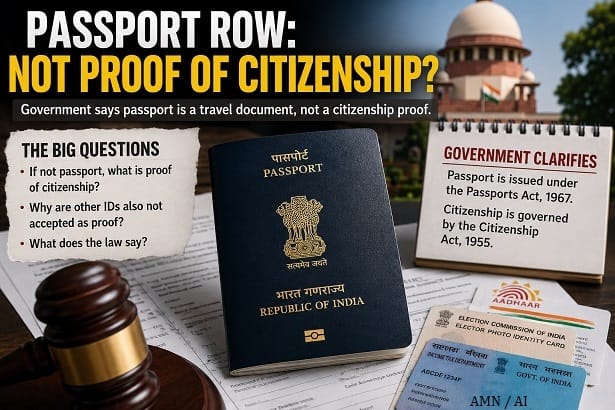
The government has maintained that the passport’s primary purpose is to facilitate international travel and establish a person’s nationality abroad. Officials pointed out that passports are issued under the Passports Act, 1967, while citizenship itself is governed by the Citizenship Act, 1955.
According to the MEA, a passport certifies that the holder is entitled to seek protection from the Indian state while overseas, but it does not serve as the definitive legal document establishing citizenship in every circumstance.
Government sources emphasized that passports are issued only after extensive verification procedures, including scrutiny of supporting documents and police verification. However, they argued that the legal framework treats passports and citizenship as two distinct concepts.
Why the Remark Triggered a Storm
The statement quickly spread across social media, where many users questioned how a document issued only after rigorous verification could fail to qualify as proof of citizenship.
Critics argued that passport applicants undergo one of the most stringent identity verification processes in the country. The document itself identifies the holder as an Indian national and is widely accepted internationally as evidence of citizenship.
Veteran lyricist and public intellectual Javed Akhtar described the government’s position as “absurd,” asking whether India would issue passports without first satisfying itself that the holder is an Indian citizen.
Political leaders across party lines also joined the debate. Independent Rajya Sabha MP Kapil Sibal questioned which document citizens should rely upon if passports, Aadhaar cards, and voter identity cards are all deemed insufficient in certain contexts.
The Legal Position
Legal experts note that the government’s clarification is technically correct.
Under Indian law, possession of a passport alone does not conclusively establish citizenship. The distinction arises because the Passports Act regulates the issuance of travel documents, whereas citizenship rights flow from the Citizenship Act.
Officials have cited judicial precedents, including a 2013 Bombay High Court judgment, which observed that passport possession cannot be treated as definitive evidence of citizenship in all legal disputes.
Former Foreign Secretary Nirupama Rao sought to explain the distinction, noting that one law governs the document while another governs the legal status of citizenship. According to her, public understanding and legal interpretation have often merged the two concepts, leading to the current confusion.
A Practical Contradiction?
Despite the legal distinction, many observers argue that the practical reality is different.
A passport remains one of the most trusted government-issued identity documents. It is accepted worldwide for visa applications, immigration clearances, financial transactions, and identity verification.
Experts point out that Section 6(2) of the Passports Act itself allows authorities to reject a passport application if the applicant is not an Indian citizen. This provision, critics argue, effectively requires the government to satisfy itself about citizenship before issuing a passport.
As a result, many legal commentators describe passports as powerful evidence of citizenship, even if they are not the final authority in a courtroom dispute over citizenship status.
The Larger Identity Crisis
The controversy has also revived concerns about India’s fragmented identity-document system.
Over the years, Aadhaar has been described as proof of identity but not citizenship. Voter identity cards establish voting eligibility but have also faced scrutiny during electoral roll verification exercises. Driving licences prove the right to drive but not citizenship.
This leaves many citizens wondering which single document conclusively establishes their status as Indians.
The debate has highlighted what experts call a “circular verification system” in which various documents depend on one another for issuance and validation, creating confusion rather than certainty.
So What Is Proof of Citizenship?
According to legal experts, the answer depends on when a person was born.
For many Indians, a birth certificate serves as the foundational document. However, amendments to citizenship laws have made the issue more complex.
Individuals born after July 1, 1987, must also establish that at least one parent was an Indian citizen at the time of birth. For those born after December 3, 2004, proof relating to the citizenship status of both parents may become relevant in certain circumstances.
For naturalised citizens, citizenship certificates issued by the government remain the primary proof.
Rise of the E-Passport
The controversy comes at a time when India is rapidly modernising its passport infrastructure.
Government officials revealed that approximately 14.7 million e-passports have been issued since the nationwide rollout of chip-based passports. These documents contain an embedded RFID chip and antenna storing personal and biometric information.
The government says the technology significantly reduces forgery risks, enhances security, and speeds up immigration clearance at international airports.
E-passports currently account for around 10 per cent of all passports in circulation, while all newly issued passports are now being produced in the chip-enabled format.
Beyond the Legal Debate
The passport controversy has exposed a deeper concern about citizenship documentation in the world’s largest democracy. While lawyers may distinguish between nationality, citizenship, and travel documents, ordinary citizens often view their passport as the ultimate government endorsement of their identity.
The latest debate has therefore become about more than legal definitions. It has reopened broader questions about documentation, identity verification, and the need for a clear and universally accepted mechanism through which Indians can establish their citizenship without ambiguity.
As the discussion continues, one thing has become clear: the passport may be legally classified as a travel document, but in public perception it remains one of the strongest symbols of Indian citizenship.