
Andalib Akhter / New Delhi
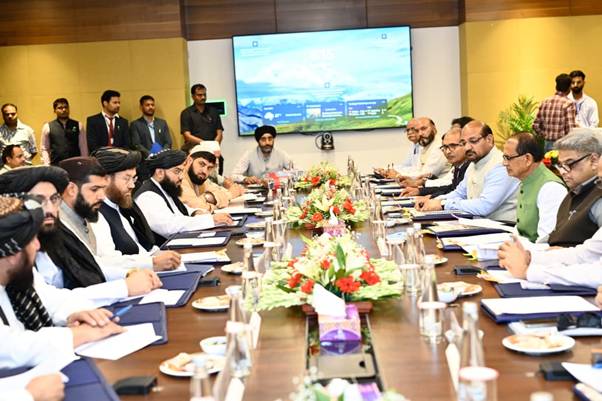
Union Minister for Agriculture & Farmers’ Welfare, Shivraj Singh Chouhan, held a high-level bilateral meeting today with his Afghan counterpart, Mawlawi Ataullah Omari, to establish a roadmap for enhanced cooperation in agriculture, irrigation, and food security.
The meeting, attended by senior officials from the Ministry of Agriculture and the Indian Council of Agricultural Research (ICAR), focused on leveraging India’s technical expertise to bolster Afghanistan’s agricultural productivity.
Key Strategic Focus Areas
- Seed Systems & Crop Productivity: With wheat identified as the backbone of the Afghan agricultural economy, India has pledged support through the provision of high-quality wheat, maize, and potato seeds. Cooperation will extend to the introduction of biofortified and climate-resilient crop varieties.
- Water Management: Addressing Afghanistan’s challenges with water scarcity, Minister Chouhan offered to share India’s successful models in micro-irrigation, rainwater harvesting, and watershed development, including the implementation of farm ponds and check dams.
- Research & Capacity Building: The two nations agreed to strengthen institutional partnerships, specifically between ICAR and Afghan agricultural institutions. Plans include joint research initiatives, faculty/student exchanges, and specialized training for Afghan veterinarians and agricultural professionals.
- Trade & Value Chains: Both Ministers highlighted the potential for expanded agri-trade, with a focus on value-added products and improving market access. The dialogue also covered prospects for private sector engagement and strengthening agricultural value chains.
Moving Toward a Structured Framework
To ensure sustained progress, both sides reached a consensus on forming a Joint Working Group. This body will be tasked with drafting a structured, long-term roadmap to streamline institutional engagement and track the implementation of projects in areas such as horticulture, dairy, fisheries, and digital agriculture.
Minister Omari expressed appreciation for India’s ongoing support, emphasizing that these initiatives are vital for Afghanistan’s economic stability. In his closing remarks, Shri Chouhan reaffirmed India’s commitment to regional cooperation, stating that sharing technological innovations and research expertise is key to ensuring sustainable food security and farmer prosperity for both nations.
Economic & Trade Impact
While total bilateral trade has fluctuated in recent years—with Afghanistan historically holding a trade surplus due to its significant exports of dry fruits, nuts, and spices to India—this new cooperation seeks to increase trade value in several ways:
- Diversification of Exports: By improving Afghanistan’s seed systems and productivity (specifically in wheat, maize, and potatoes), the country will be better positioned to move beyond raw agricultural goods toward higher-value processed agricultural products.
- Strengthening Value Chains: A key goal is to improve post-harvest management and cold-chain infrastructure. This reduces wastage and allows Afghan farmers to access premium international markets, including India, with higher-quality produce.
- B2B and Private Sector Engagement: The move toward a “Joint Working Group” is intended to foster business-to-business (B2B) linkages. By standardizing quality through scientific cooperation, both nations are creating a framework that reduces trade risks for private investors and agricultural traders.
- Infrastructure Connectivity: The collaboration leverages existing logistical assets like the Chabahar Port and the Air-Freight Corridor, which remain vital for bypassing transit hurdles and ensuring that agricultural goods reach Indian markets efficiently.
Technology Transfer Areas
India’s role is primarily that of a knowledge partner, transferring proven, low-cost, and scalable technologies that are highly relevant to Afghanistan’s current challenges:
| Focus Area | Indian Technological Contribution |
| Water Efficiency | Micro-irrigation systems, rainwater harvesting, farm ponds, and check dams. |
| Crop Improvement | High-yield, climate-resilient, and biofortified seed varieties (wheat, maize). |
| Scientific Support | ICAR-led training for Afghan scientists, veterinarians, and extension workers. |
| Digital/Soil Health | Modern soil testing techniques and digital agriculture tools to optimize farm inputs. |