
Last Updated on June 16, 2026 11:37 pm by BIZNAMA NEWS
AMN / NEWS
The G7 nations have announced a series of initiatives to strengthen global health and development cooperation, with several partner countries, including India, extending their support. The G7 leaders called for a coordinated international response to the re-emerging Ebola outbreak in the Democratic Republic of the Congo and Uganda. India, Egypt, Kenya and South Korea joined the appeal for enhanced measures, including contact tracing, border surveillance and community engagement. The leaders also pledged support for the development of vaccines, diagnostics and treatments for the rare Ebola strain.
The G7 further reaffirmed its commitment to accelerating the global fight against cancer. Supported by partner countries, including India and Brazil, the leaders stressed the importance of prevention, early diagnosis and access to quality healthcare, while advocating greater cooperation in cancer research and the responsible use of emerging technologies.
The grouping also reiterated its commitment to international cooperation in development and investment finance to support vulnerable countries and promote sustainable and resilient growth.
A Unified Global Front on Cancer Research
For the first time in the history of the G7 Leaders’ Summit, the fight against cancer took a primary slot on the diplomatic agenda, driven by data indicating that global cancer cases will jump by 80% by 2050.
Supported strongly by India and Brazil, the summit leaders underscored that scientific innovation must be translated into patient care far more quickly. The international oncology push focuses heavily on:
- Standardizing data-sharing mechanisms for pediatric and adolescent cancers.
- Expanding global screening, early detection networks, and preventative care.
- Integrating emerging artificial intelligence (AI) technologies safely and responsibly within translational research frameworks.
PM Modi participates in high-level G7 working session in Evian

Prime Minister Narendra Modi is participating in a high-level working session at the ongoing G7 Summit in Evian, France, today. The session, themed “Forging New Partnerships and Rebuilding International Solidarity,” brought together leaders of the G7 nations, partner countries, and senior representatives from the World Bank and the African Development Bank.
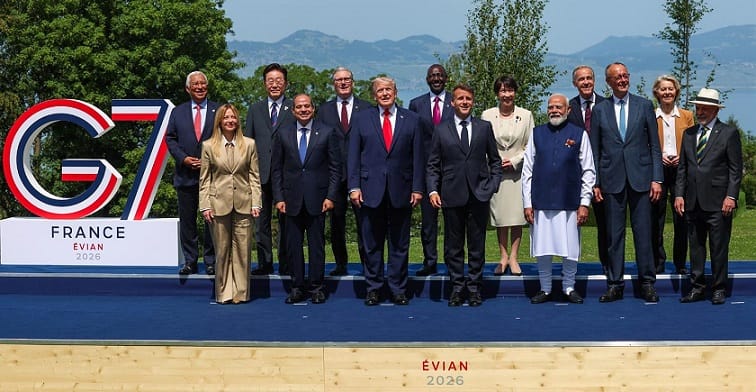
The meeting began shortly after French President Emmanuel Macron formally welcomed PM Modi and other participating leaders. Following a group photograph, PM Modi shared the picture on social media, stating that India and the G7 countries would continue to work closely to promote global prosperity, sustainability and human well-being.
Earlier in the day, PM Modi arrived in Evian on a two-day visit to attend the Summit, which commenced yesterday. In a social media post after his arrival, the Prime Minister said he looked forward to engaging with world leaders and exchanging views on key global issues. He added that India remains committed to advancing collective efforts towards a more sustainable and prosperous planet.
The Summit assumes considerable strategic importance for India, with PM Modi expected to strongly articulate the concerns and priorities of the Global South. India’s regular participation in the G7 outreach process reflects its expanding role in addressing global challenges and contributing to international efforts relating to peace, security, sustainable development and economic growth.
On the sidelines of the Summit, the Prime Minister is scheduled to hold bilateral meetings with Canadian Prime Minister Mark Carney, United Kingdom Prime Minister Keir Starmer, and President of the United Arab Emirates Sheikh Mohamed bin Zayed Al Nahyan. Later this evening, he will attend a gala dinner to be hosted by President Macron.
A key engagement during the Summit will be PM Modi’s meeting tomorrow with US President Donald Trump. The two leaders are expected to discuss ways to further strengthen bilateral cooperation across a range of sectors, besides exchanging views on important regional and global developments of mutual interest.