
Last Updated on June 4, 2026 1:07 am by BIZNAMA NEWS
Aafreen Hussain
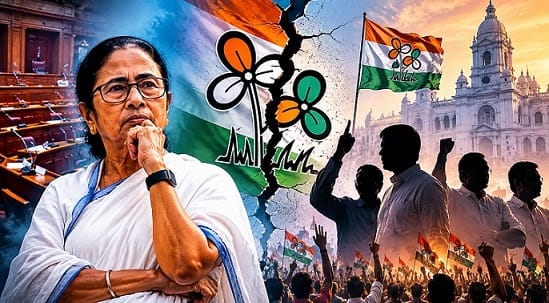
West Bengal’s political landscape has entered one of its most uncertain moments as the Trinamool Congress (TMC) faces a serious internal crisis. What began as reports of dissatisfaction inside the legislative wing has now grown into a larger debate over leadership, organisational control, political succession, and the future of one of India’s most influential regional parties.
The rebellion inside the Assembly, followed by claims of support from a large section of legislators and the emergence of an alternative leadership narrative, has created political shockwaves across the state. In response, the TMC leadership announced the immediate dissolution of all organisational committees and frontal organisations in West Bengal and promised a complete review and restructuring exercise.
TMC Split Deepens: Ritabrata Banerjee Emerges as Rebel Face, Assembly Battle Intensifies-
West Bengal politics witnessed dramatic developments as internal divisions inside the Trinamool Congress (TMC) moved into the Assembly and triggered a full-scale political crisis. Reports indicate that a rebel faction led by expelled MLA Ritabrata Banerjee claimed support from nearly 58–60 legislators and sought recognition as the legitimate legislative group inside the Assembly.
The controversy began after allegations of forged signatures surfaced over a letter related to nominations for key Assembly positions, including the Leader of the Opposition. TMC MLAs Ritabrata Banerjee and Sandipan Saha questioned the authenticity of signatures and raised objections, leading to a major confrontation inside the party.
Soon after, the Trinamool Congress expelled both Ritabrata Banerjee and Sandipan Saha, accusing them of anti-party activities and repeated defiance of party discipline.
The political crisis escalated when the rebel camp submitted a letter to Assembly Speaker Rathindra Bose and reportedly claimed majority backing inside the legislature party. Ritabrata Banerjee later announced that he had been recognised as Leader of the Opposition and declared the rebel bloc to be the “real and main opposition” in the Assembly.
Reports also suggested that names of other TMC legislators emerged alongside the rebellion, while discussions around alternative legislative positions gathered momentum. Sources mentioned Akhruzzaman in the proposed rebel leadership arrangement.
Facing mounting pressure, TMC leadership announced the dissolution of all party committees and frontal organisations across West Bengal and launched a complete organisational review and restructuring exercise.
But this decision itself raises difficult questions. If the organisation remained united and stable, why was such a sweeping organisational reset necessary?
For years, TMC projected itself as a disciplined political machine under Mamata Banerjee’s leadership. The slogan “Khela Hobe” became more than a campaign line it symbolised confidence, control and political momentum. Today, however, the debate has shifted from political dominance to political survival.
The biggest question is whether this crisis is ideological or organisational. Are the differences emerging because of political direction, or has dissatisfaction grown over decision-making and concentration of influence inside the party structure?
Another uncomfortable question now enters public discussion succession.
Mamata Banerjee remains the undisputed public face of TMC, but recent events have intensified speculation about the balance between established leadership and emerging power centres.
Can a party built around a powerful central figure successfully manage internal transition without creating resistance? The reported criticism from dissident voices suggests that this may no longer be a question for the future but a challenge of the present.
At the same time, writing political obituaries has historically been risky in West Bengal politics. Mamata Banerjee has repeatedly returned stronger after facing opposition, criticism and political setbacks. Her supporters argue that restructuring is not a sign of collapse but a strategy to identify weaknesses and rebuild authority.
Yet rebuilding requires more than organisational announcements. It demands restoring trust, containing factionalism and presenting a clear political message to workers and voters.
The next phase will determine whether TMC emerges as a renewed force or whether this moment marks the beginning of a long political transition.
One question now hangs over Bengal politics: Will this be remembered as the rebellion that strengthened TMC or the turning point that changed the party’s future forever?
The crisis has now raised a larger political question: Is this only an internal revolt, or the beginning of a new chapter in West Bengal politics?