
Last Updated on May 16, 2026 12:21 pm by BIZNAMA NEWS
True measure of an economy is not merely GDP growth figures, but the condition of the ordinary citizen’s plate and savings. Today, both appear to be under growing strain.
By Pravin Kumar and Andalib Akhter
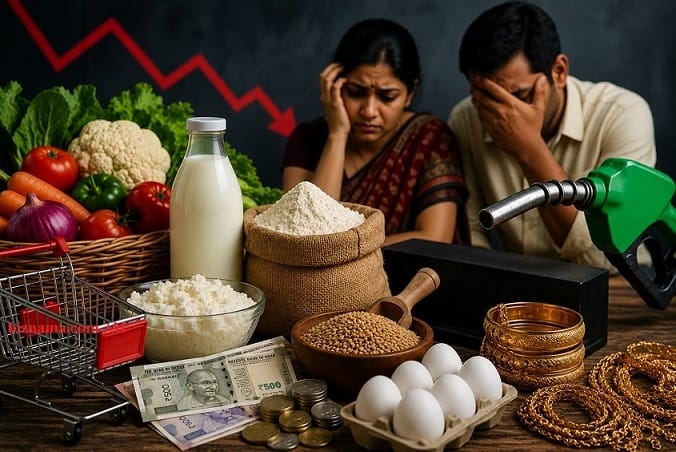
In less than 48 hours, the financial anxieties of millions of Indians deepened dramatically. What began with a record-breaking surge in gold prices quickly spread to household kitchens as milk became costlier, before rising petrol, diesel and CNG prices delivered yet another blow to already stretched family budgets. For ordinary citizens, the past two days have not merely reflected routine price fluctuations; they have exposed the growing fragility of an economy where every essential — from food and fuel to savings and transport — is becoming increasingly expensive.
At a time when wholesale inflation has climbed to a 42-month high and the rupee continues to weaken sharply against the US dollar, the warning signs are becoming difficult to ignore. Economists fear that India may be entering a dangerous phase where inflation, slowing demand and weakening purchasing power begin feeding into one another, both economic growth and the financial stability of the middle class.
This is not merely a case of a few commodities becoming costlier. It reflects deeper structural stress within the Indian economy. With wholesale inflation climbing to a 42-month high and the rupee sliding to record lows against the US dollar, concerns are growing over whether inflationary pressures are slipping beyond control.
A Three-Pronged Inflation Shock
Inflation in India is often viewed through the narrow lens of food and vegetable prices. However, the current situation is far more complex. This time, inflation is hitting from three directions simultaneously.
First, global uncertainty has pushed gold prices sharply higher. For Indian households, gold is not just jewellery but also a traditional safe-haven investment. Rising gold demand usually signals fear and instability in the broader economy.
Second, higher milk prices have a cascading effect across the economy. Milk is a core household necessity, and any increase directly impacts the prices of tea, sweets, ghee, paneer and other dairy products. This, in turn, places additional pressure on the nutritional spending of lower and middle-income families.
Third, rising petrol, diesel and CNG prices act as a silent inflation multiplier. Since the bulk of India’s freight transportation depends on roads, higher fuel costs eventually raise the prices of vegetables, consumer goods and industrial products alike. Every stage of the supply chain becomes more expensive.
Rupee Weakness Deepens the Crisis
The depreciation of the rupee against the dollar is emerging as one of the biggest challenges for the Indian economy. A weaker rupee automatically increases India’s import bill, particularly for crude oil, electronics and industrial raw materials.
Several factors are contributing to this decline. Higher interest rates in the United States have encouraged global investors to shift funds into dollar-denominated assets. Continuous selling by Foreign Portfolio Investors (FPIs) in Indian equity markets has also reduced dollar inflows. At the same time, India’s widening trade deficit — driven by high imports and comparatively weaker exports — is putting additional pressure on the currency.
The impact goes beyond currency markets. Since India imports more than 80 per cent of its crude oil requirements, a weaker rupee directly translates into costlier fuel and imported inflation for ordinary consumers.
Why Wholesale Inflation Matters
The sharp rise in the Wholesale Price Index (WPI) is being viewed by economists as an early warning signal. WPI reflects the prices at which manufacturers and wholesalers purchase goods and raw materials.
When the wholesale prices of cement, steel, chemicals and fuel rise, companies are eventually forced to pass these costs on to consumers. This means today’s wholesale inflation often becomes tomorrow’s retail inflation. Sectors such as construction, automobiles and fast-moving consumer goods (FMCG) are likely to feel the impact most strongly in the coming months.
Middle-Class Households Under Pressure
For a middle-class family earning between ₹40,000 and ₹50,000 a month, the arithmetic of survival is becoming increasingly difficult.
Rising milk and food prices alone could add ₹1,000–₹1,500 to monthly household expenses. Higher fuel costs mean increased commuting expenses as well as likely hikes in school transport, taxi and auto fares. Costlier electricity, construction materials and logistics could also push up housing and rental costs.
Overall, economists estimate that middle-class households may face an additional monthly burden of ₹3,000–₹5,000. For lower-income groups, the situation is even more severe because a larger share of their earnings is spent on food and transportation.
This rise in expenditure is not linked to luxury consumption but to essential needs. As a result, discretionary spending on travel, entertainment, dining out and consumer goods tends to decline, eventually slowing overall demand in the economy.
Government and RBI Face a Difficult Choice
The situation has placed both the government and the Reserve Bank of India in a difficult position.
If the government cuts excise duties on petrol and diesel to provide relief, it risks significant revenue losses that could affect welfare and infrastructure spending. On the other hand, if the RBI raises interest rates aggressively to control inflation, loans become more expensive, investments slow down and economic growth weakens.
Global geopolitical tensions — including instability in the Middle East and disruptions linked to international conflicts — continue to keep crude oil prices elevated, limiting India’s policy flexibility.
The Risk of Stagflation
One of the biggest concerns is the possibility of stagflation — a situation where high inflation coexists with slow economic growth and rising unemployment.
India’s headline growth figures still appear relatively strong compared to many global economies. However, weak rural demand and sluggish private investment suggest that the underlying economic picture may be less reassuring. When incomes stagnate while expenses continue to rise, consumer spending weakens and the economic cycle begins to slow.
The Road Ahead
The coming months are unlikely to bring immediate relief. An uncertain monsoon could further push up food prices. If the rupee weakens beyond ₹95–₹96 per dollar, imported inflation may become even harder to contain.
Economists believe that improving supply chains and reducing transportation and storage costs through long-term infrastructure investment will be essential. Temporary relief through cuts in fuel taxes by both the Centre and states could also help contain inflationary pressures.
At the same time, greater attention must be given to employment generation and support for the MSME sector to strengthen purchasing power and sustain domestic demand. Infrastructure spending alone may not be sufficient to stabilise the economy.
The inflation surge witnessed over the past 48 hours may not be an isolated event but rather a reflection of deeper structural vulnerabilities within the Indian economy. It may be premature to say that the economy is entirely slipping out of control, but it is increasingly evident that the margin for policy error is narrowing rapidly.
Ultimately, the true measure of an economy is not merely GDP growth figures, but the condition of the ordinary citizen’s plate and savings. Today, both appear to be under growing strain.